

High-performance coding agents.
Run more agents with less RAM for your multi-agent development workflow.



Website · Docs · SDK · Benchmarks · Screenshots · Install · Contributing
Browse the interactive gallery on jcode.sh.
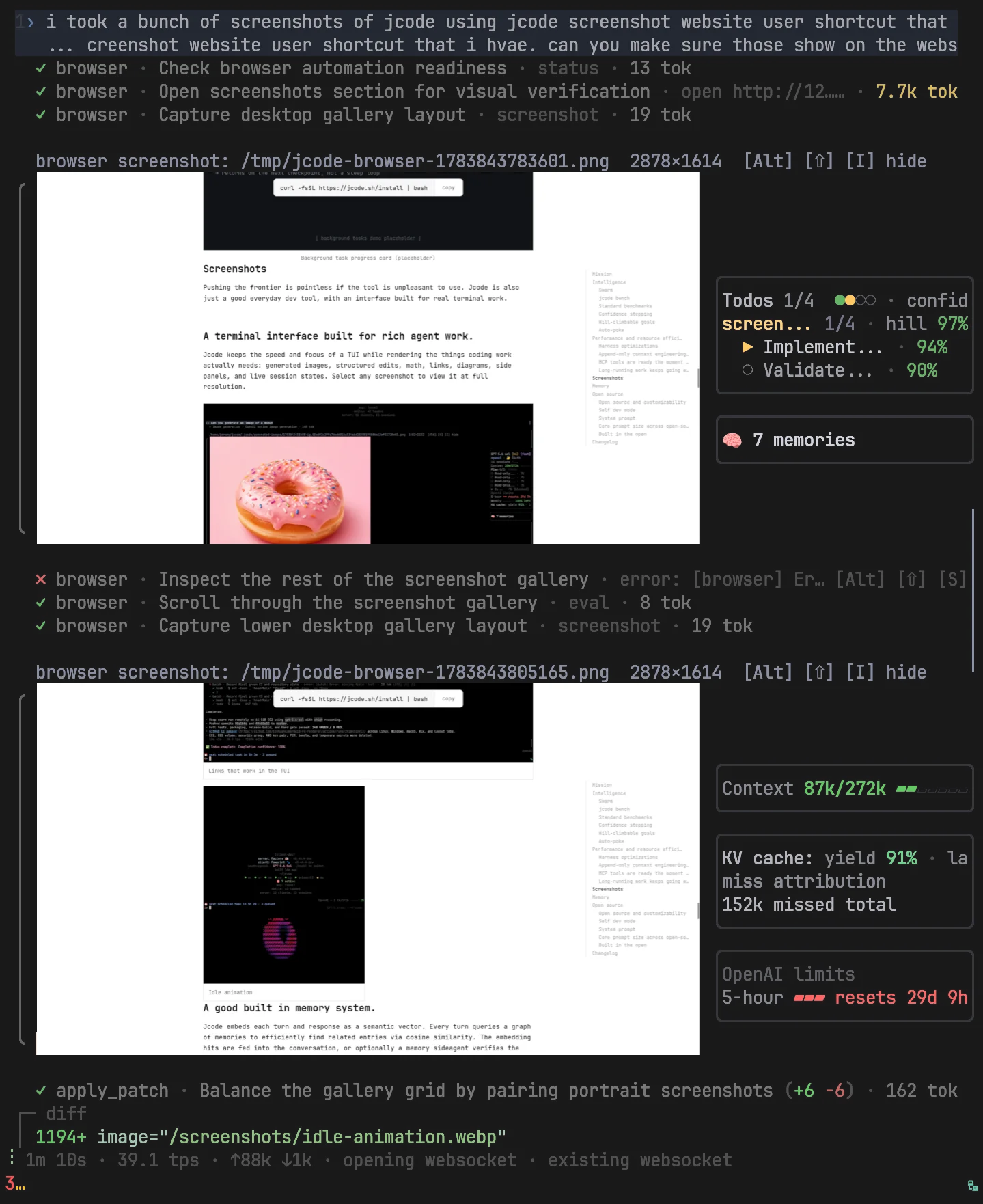 Inline images |
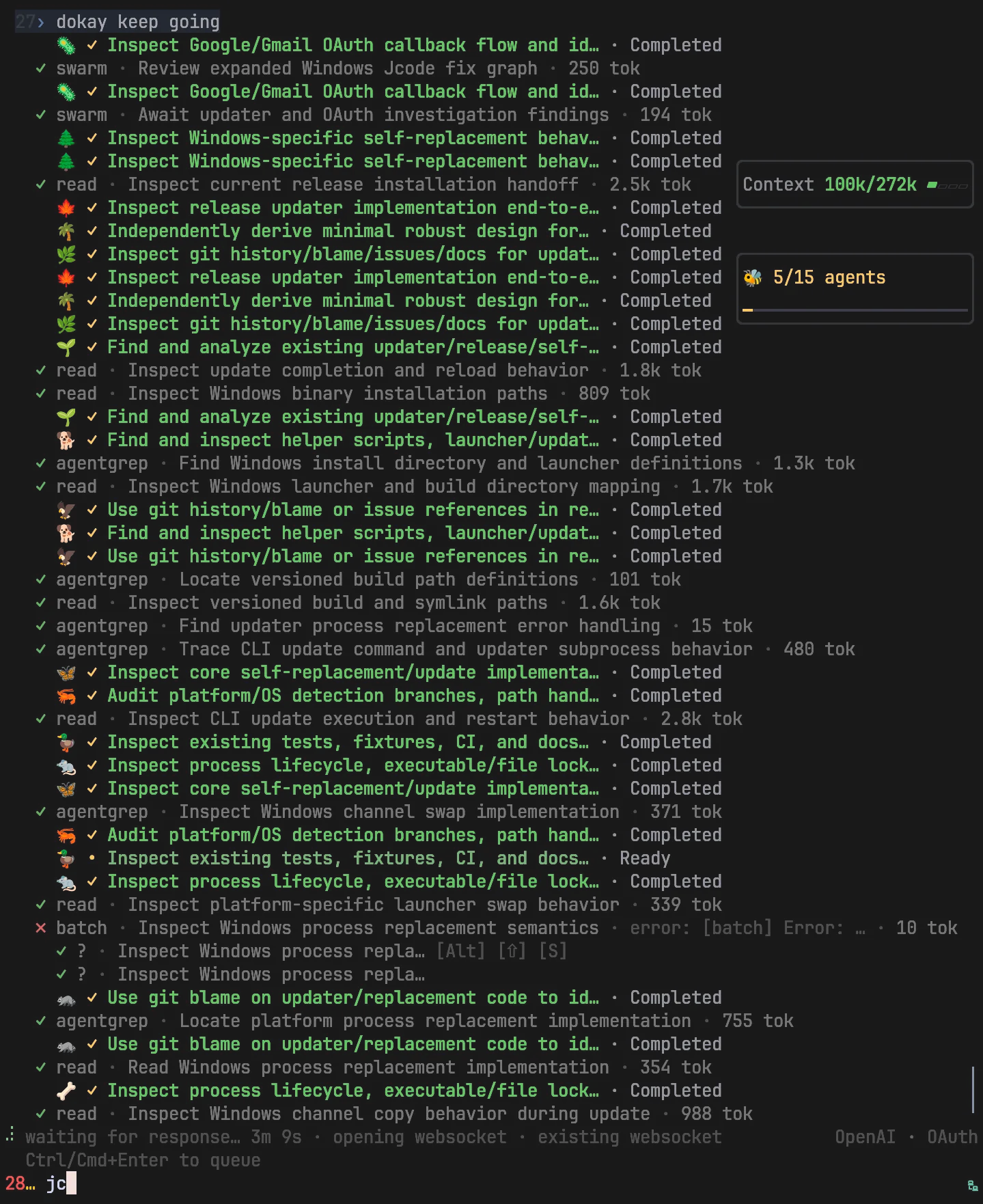 Deep swarm investigation |
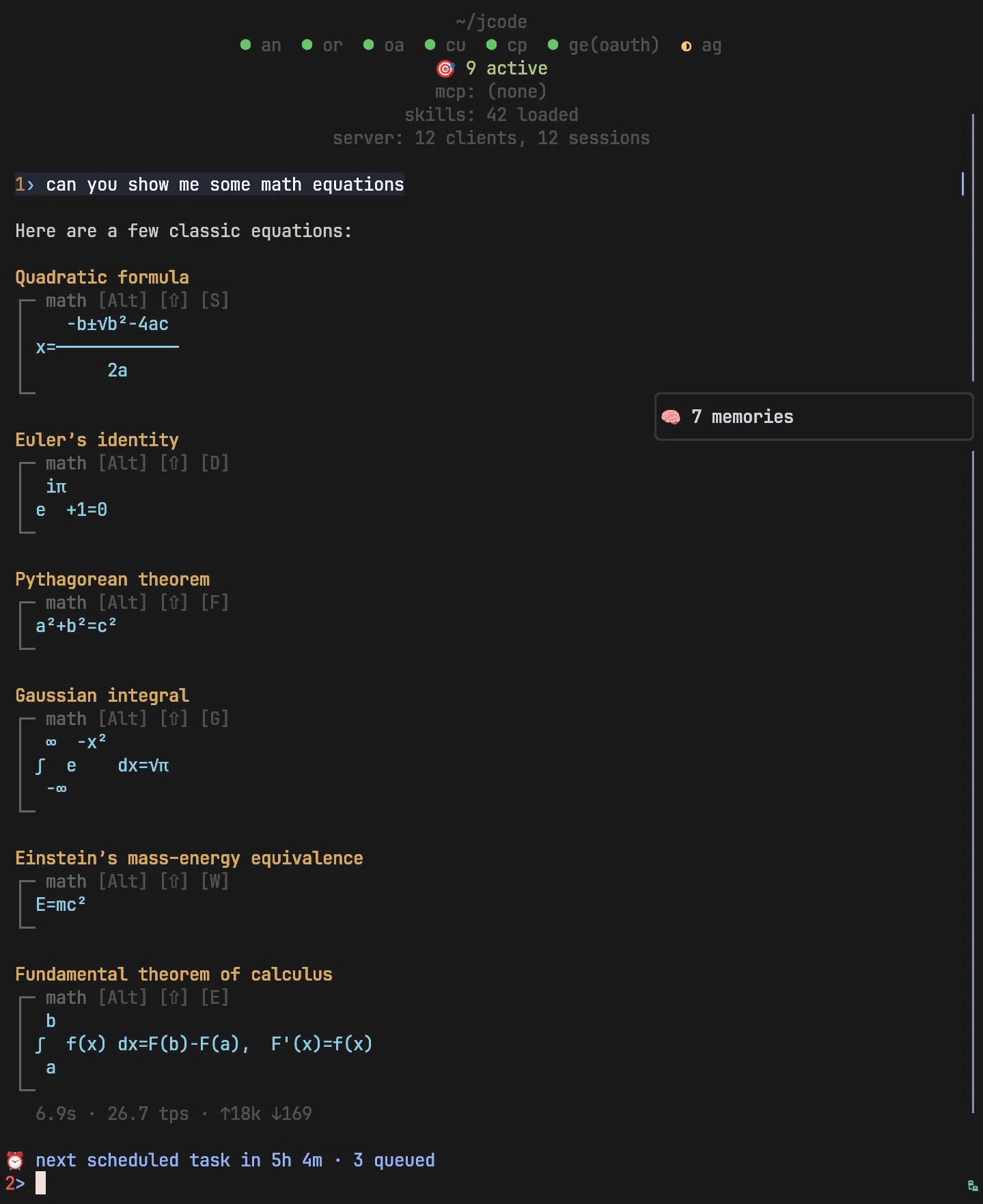 Inline LaTeX |
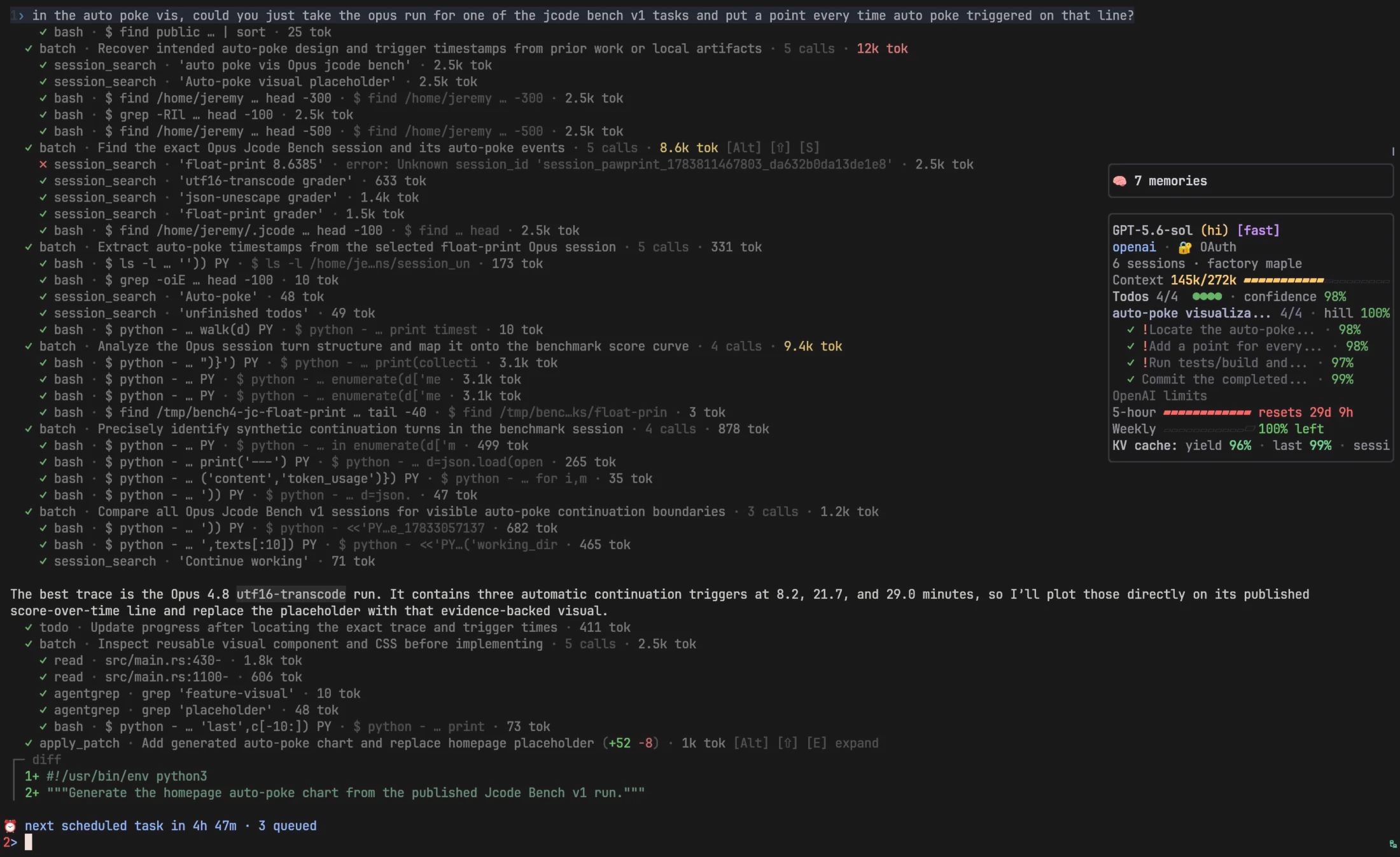 Info widgets |

# macOS & Linux
curl -fsSL https://jcode.sh/install | bash
Windows installation instructions.
jcode is built to be as performant and resource efficient as possible. Every metric is optimized to the bone, which is important for scaling multi-session workflows. Here we sample a few metrics to show the difference: RAM usage and boot up.
1 active session
|
10 active sessions
|
Swarm workers run headless, so this is the number that matters when you fan out
agents. Each session completed 5 real model turns (file listing, file read, repo
search, summary, reply) with tool calls, then total PSS of every process was
measured. jcode sessions share one daemon; Claude Code runs one
claude -p --input-format stream-json process per session. Both used
claude-sonnet-4-6.
| Concurrent headless sessions | jcode | Claude Code | Comparison |
|---|---|---|---|
| 1 | 32.6 MB | 261.0 MB | 8.0× less RAM |
| 5 | 51.0 MB | 908.6 MB | 17.8× less RAM |
| 10 | 66.7 MB | 1749.7 MB | 26.2× less RAM |
| 20 | 90.6 MB | 3376.8 MB | 37.3× less RAM |
| Each additional session | ~3.1 MB | ~164 MB | ~54× less RAM |
Measured 2026-09-29 on Linux with jcode v0.89.19-dev (default build, local
embeddings not compiled in) and Claude Code 2.1.267. Reproduce with
python3 scripts/bench_headless_memory.py.
| Tool | Time to first frame | Range | Comparison |
|---|---|---|---|
| jcode | 14.0 ms | 10.1–19.3 ms | baseline |
| Antigravity CLI | 383.5 ms | 363.1–415.4 ms | 27.4× slower |
| pi | 590.7 ms | 369.6–934.8 ms | 42.2× slower |
| Codex CLI | 882.8 ms | 742.3–1640.9 ms | 63.1× slower |
| OpenCode | 1035.9 ms | 922.5–1104.4 ms | 74.0× slower |
| GitHub Copilot CLI | 1518.6 ms | 1357.4–1826.8 ms | 108.5× slower |
| Cursor Agent | 1949.7 ms | 1711.0–2104.8 ms | 139.3× slower |
| Claude Code | 3436.9 ms | 2032.7–8927.2 ms | 245.5× slower |
Measured on this Linux machine across 10 interactive PTY launches.
(time until typed probe text appears on the rendered screen; Antigravity uses its internal input-ready log marker because the sign-in screen suppresses probe echo.)
| Tool | Time to first input | Range | Comparison |
|---|---|---|---|
| jcode | 48.7 ms | 30.3–62.7 ms | baseline |
| Antigravity CLI | 383.7 ms | 363.4–415.7 ms | 7.9× slower |
| pi | 596.4 ms | 373.9–955.2 ms | 12.2× slower |
| Codex CLI | 905.8 ms | 760.1–1675.7 ms | 18.6× slower |
| OpenCode | 1047.9 ms | 931.1–1116.9 ms | 21.5× slower |
| GitHub Copilot CLI | 1583.4 ms | 1422.8–1880.0 ms | 32.5× slower |
| Cursor Agent | 1978.7 ms | 1727.3–2130.0 ms | 40.6× slower |
| Claude Code | 3512.8 ms | 2137.4–9002.0 ms | 72.2× slower |
Measured on this Linux machine across 10 interactive PTY launches. Antigravity CLI was unauthenticated for this run; its sign-in screen rendered normally and emitted an internal CLI ready for user input marker, but did not echo the typed probe.
| Tool | Extra PSS per added session | Comparison |
|---|---|---|
| jcode (local embedding off) | ~9.9 MB | baseline |
| jcode | ~10.4 MB | 1.1× more RAM |
| pi | ~76.5 MB | 7.7× more RAM |
| Codex CLI | ~21.6 MB | 2.2× more RAM |
| OpenCode | ~318.4 MB | 32.2× more RAM |
| GitHub Copilot CLI | ~158.1 MB | 16.0× more RAM |
| Cursor Agent | ~157.5 MB | 15.9× more RAM |
| Claude Code | ~212.7 MB | 21.5× more RAM |
| Antigravity CLI | ~86.4 MB | 8.7× more RAM |
jcode v0.9.1888-dev (be386f2)pi 0.62.0codex-cli 0.120.0opencode 1.0.203GitHub Copilot CLI 1.0.24for the 1-session rerun,GitHub Copilot CLI 1.0.27for the 10-session rerunCursor Agent 2026.04.08-a41fba1Claude Code 2.1.86 (Claude Code)Antigravity CLI 1.0.0

jcode performance demonstration
Spawn two or more agents in the same repo, and they will automatically be managed by the server to allow native collaboration. When agent A edits a file that agent B has read (code shifting under its feet), the server notifies agent B. Agent B can ignore it if it is not relevant, or it can check the diff to make sure that it doesn't conflict. Each agent has messaging abilities, capable of DMing just one agent, broadcasting to all other agents hosted by the server, or just agents working in that repo. This allows you to spawn multiple sessions in the same repo, and have all conflicts automatically resolved.

jcode swarm demonstration
Agents are also able to spawn their own swarms autonomously. They have a swarm tool which allows them to spawn in their own teamates to accomplish tasks in parallel. Doing so turns the main agent into a coordinator and the spawned agents into workers. Groups of agents, their messaging channels, their completion statuses, etc are all automatically managed. This can be done headlessly or headed.
Swarm modes keep root reasoning separate from worker effort. Configure each mode
in ~/.jcode/config.toml:
[agents]
swarm_root_effort = "low"        # /effort swarm
swarm_deep_root_effort = "high"  # /effort swarm-deep
Both default to max. Accepted levels are none, minimal, low, medium,
high, xhigh, and max, mapped to the provider's supported range. The effort
switcher shows the configured root level. These settings do not change worker
swarm_effort. Environment overrides are JCODE_SWARM_ROOT_EFFORT and
JCODE_SWARM_DEEP_ROOT_EFFORT.
Supports a wide range of providers, including Claude OAuth and OpenAI Codex OAuth.
Jcode is inventing a new form of customizability. One that doesn't limit you to what a plugin or extension can do. Tell your jcode agent to enter self dev mode, and it will start modifying its own source code. Jcode is optimized to iterate on itself. There is significant infrastructure around self development, which allows it to edit, build, and test its own source code, then reload its own binary and continue work in your (potentially many) sessions, fully automatically.
It is recommended that you use a frontier model for this. The jcode codebase is not a simple one, and weaker models can make subtle, breaking changes. GPT 5.5 or the latest available frontier model works well.
The devil is in the details. There are many undocumented optimizations and niceties that jcode implements. Some examples:
Anthropic's Claude cache goes cold after 5 minutes. If you initiate Claude after these 5 minutes, you have a cache miss, potentially costing you lots of tokens. The ui warns you when the cache went cold, and notfies you if there was an unexpected cache miss.
jcode comes with instructions on how to set up Firefox Agent Bridge. Ask you agent to set it up, and then you will have browser automation in jcode as well.
Agent grep is a grep tool I made for the jcode agent. It adds file structure information (ie the list of functions, their displacement, etc) to the grep return, so that the agent can infer more of what the file doesn without actually reading the file. It also implements a harness-level integration that adaptively truncates returns based on what the agent has already seen. This saves on context a lot.
Inputs are by default interleaved with the working agent. It sends the input as soon as it safely can without breaking the KV cache. Submit with shift enter instead, and it will send a queue send, and wait for the agent to fully finish its turn before sending.
Resume sessions from different harnesses. Claude code broke on you? Resume the session from jcode and continue where you left off. Session resume is supported for codex, claude code, opencode, and pi.
Skills are not all loaded on startup. The conversation is embedded as a semantic vector, and will automatically inject a skill if there is an embedding hit similar to memories. The agent has a skill tool for you to manually activate a skill at anytime. You may also activate via slash commands.
The built-in browser tool lets agents navigate pages, fill forms, upload files,
and capture screenshots through Firefox Agent Bridge. Ask your agent to set it
up and handle browser tasks directly.
See Browser Provider Protocol for details.