


Bounded Origin is an HTTP gateway and Java library for controlling expensive server-side work. Equivalent requests can share one computation, new work runs within explicit limits, and saved results can be reused across restarts.

Serving a result can be cheap while producing it is expensive. Request counts alone do not capture that cost: many URLs may ask for the same work, while distinct requests can continuously create new work on cache miss.
You configure which inputs identify the same operation and set global and
per-policy limits on active and queued work. Excess requests receive 503 with
Retry-After; unclassified requests are denied. The configuration guide
covers routing, budgets and the five policy strategies.
Bounded Origin Git is an independent application built on the released Bounded Origin 0.1.0 libraries. It serves cgit pages rendered ahead of time, so anonymous traffic does not trigger cgit rendering.
In its Linux/cgit campaign, across 47,200 measured Bounded Origin attempts, anonymous requests caused zero native cgit executions. For the 512-page unique crawl, prepared BO delivered 512/512 representations in every one of ten measured repetitions, again with zero request-triggered cgit.
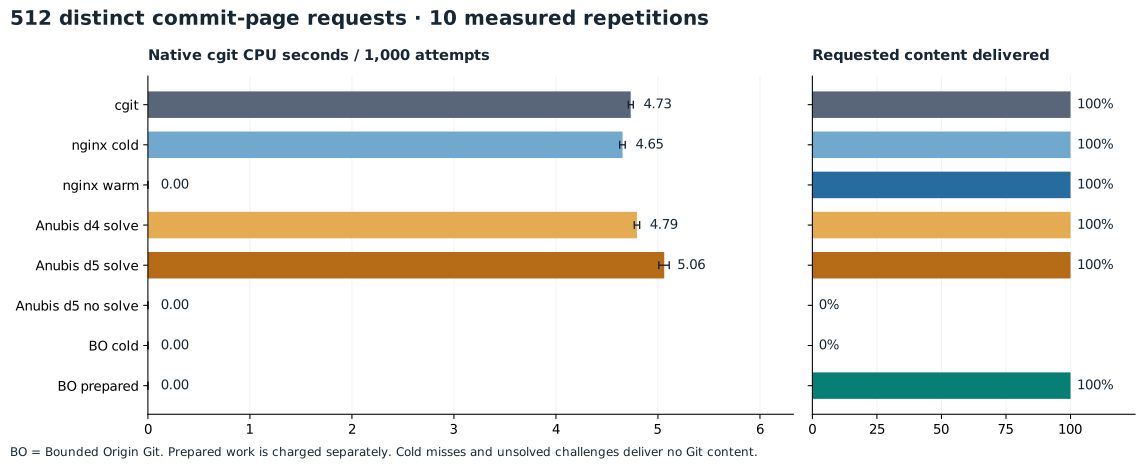
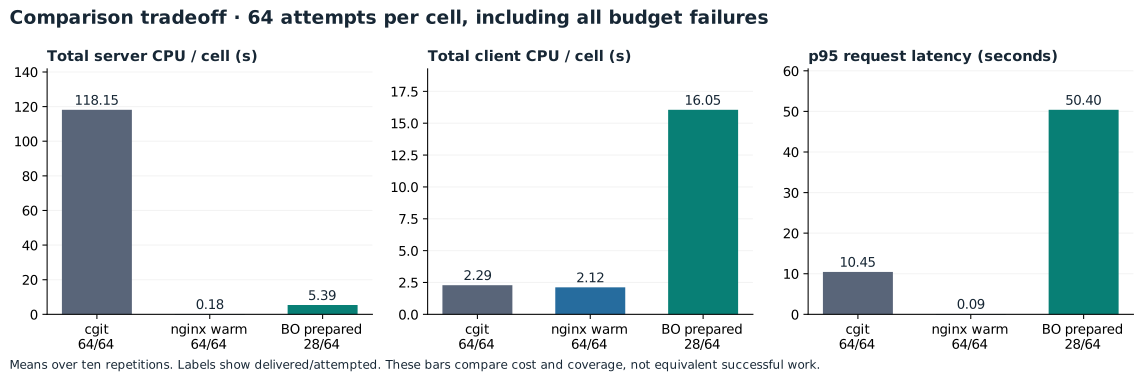
Preparation required 512 trusted renders; unprepared pages return 404. Client-side comparisons have a separate cost and coverage tradeoff:
Full results, preparation costs and reproduction instructions.
The gateway runs from YAML and requires Java 21. Download the
0.1.0 distribution:
bounded-origin-0.1.0.tar for POSIX or bounded-origin-0.1.0.zip for Windows.
Dependencies are included.
Save materialize.yaml and public_origin.py beside the archive. Start the demo origin in one terminal (Python 3 required):
python public_origin.pyIn a second terminal, extract, validate and run:
tar -xf bounded-origin-0.1.0.tar
./bounded-origin-0.1.0/bin/bounded-origin validate --config materialize.yaml
./bounded-origin-0.1.0/bin/bounded-origin run --config materialize.yaml
Windows PowerShell commands
Expand-Archive .\bounded-origin-0.1.0.zip -DestinationPath .
.\bounded-origin-0.1.0\bin\bounded-origin.bat validate --config materialize.yaml
.\bounded-origin-0.1.0\bin\bounded-origin.bat run --config materialize.yaml
In another terminal, send two equivalent requests (use curl.exe on PowerShell):
curl "http://127.0.0.1:8080/hello/world?noise=one"
curl "http://127.0.0.1:8080/hello/%77orld?noise=two"
Both return Hello from /hello/world. The first saves the result; the second
reuses it. Restart from the same working directory to reuse it again. State lives
in bounded-origin-data/; listeners bind to loopback.
Next: adapt the configuration and inspect metrics, health and readiness.
Add the core engine from Maven Central:
dependencies {
    implementation("io.github.aalsanie:bounded-origin-core:0.1.0")
}
Maven equivalent and other modules
<dependency>
    <groupId>io.github.aalsanie</groupId>
    <artifactId>bounded-origin-core</artifactId>
    <version>0.1.0</version>
</dependency>| Module | Purpose |
|---|---|
bounded-origin-api |
Framework-independent public contracts. |
bounded-origin-core |
Policy and execution engine; includes the API. |
bounded-origin-store-fs |
Filesystem artifact storage. |
bounded-origin-proxy |
Embeddable HTTP gateway; includes the core and API. |
The generic benchmark campaign compares a synthetic CPU origin
with shared computation (BOUNDED_COMPUTE) and saved results (MATERIALIZE). It
uses the packaged gateway, independent origin-side work counts and the same
origin workload, on Java 21 in a shared WSL2 environment.
For 256 requests naming one operation at concurrency 64, across 10 measured repetitions, both gateway strategies used active capacity 1 and queue capacity 0:
| Path | Origin executions, mean [min, max] | Maximum actual origin concurrency |
|---|---|---|
| Direct origin | 256 [256, 256] | 45 |
BOUNDED_COMPUTE |
10 [9, 13] | 1 |
MATERIALIZE |
1 [1, 1] | 1 |
There is a latency cost. In the separate sequential-request comparison,
the median of per-trial p99 latencies was 81.5 ms through BOUNDED_COMPUTE
versus 20.4 ms directly.
Routing and operation-key costs grow with configuration complexity. Full results, charts, raw evidence and reproduction commands are in Benchmarks.
Responses must be safe to share. The HTTP gateway serves public results; stored results must remain valid for their versioned identity. Caller-specific, authenticated, conditional and range responses are outside this model. The origin must affirm public sharing; see the response contract.
A timeout does not prove computation stopped. The origin must finish all work, including delegated work, before its complete response. Uncertain work retains capacity indefinitely, including across restarts. Preserve the exclusive ownership state and route all work being bounded through that domain. Read the ownership and recovery requirements before deployment.
Bounded Origin complements authentication, TLS termination, rate limits and CDN/WAF controls. It does not identify bots or stop incoming traffic.
The runtime is AGPL-3.0-only; bounded-origin-api is Apache-2.0.
See Licensing for terms and Security to report a vulnerability.