

Cholesky modifications in JAX, with differentiable tensor operations and immutable factor objects. cholops provides fast appends, deletions and updates of a dense positive-definite matrix's factor, directly or through a factor object.
Install with pip install cholops. On Linux with a compatible CUDA 13 driver,
use pip install "cholops[cuda13]". The initial release targets JAX 0.11.2 and
Python 3.12 or newer.
We recommend using float64; see JAX's precision settings.
Set the JAX_ENABLE_X64 shell environment variable before starting Python:
export JAX_ENABLE_X64=1Alternatively, enable it in Python before creating arrays:
import jax

jax.config.update("jax_enable_x64", True)import jax
import jax.numpy as jnp
from cholops import Cholesky, PermutedCholesky
A = jnp.array([[2.0, 0.3, 0.1], [0.3, 1.5, 0.2], [0.1, 0.2, 1.2]])
b = jnp.array([1.0, -0.5, 0.2])
# Create a Cholesky factor from a positive-definite matrix.
factor = Cholesky.from_matrix(A)
factor = factor.append(jnp.array([[0.2], [0.1], [0.05]]), jnp.array([[1.3]]))
L = factor.factor
x = factor.solve(
jnp.append(b, 0.4)
) # One RHS entry per variable, including the new one.
# PermutedCholesky replaces by deletion and appending,
# while managing logical ordering transparently.
managed = PermutedCholesky.from_matrix(A)
updated = managed.replace(1, jnp.array([[0.2], [0.1]]), jnp.array([[1.3]]))
x_new = updated.solve(b) # Inputs and outputs remain in logical order.
# Zero-mean Gaussian log likelihood and its covariance/data gradients.
@jax.jit
def log_likelihood(A, b):
state = Cholesky.from_matrix(A)
return -0.5 * (state.logdet() + state.quadratic(b) + b.size * jnp.log(2 * jnp.pi))
logp, (grad_A, grad_b) = jax.value_and_grad(log_likelihood, argnums=(0, 1))(A, b)See the factor guide for more information.
Here are a few examples of how to use cholops:
- Basic factor operations: add, replace and remove observations, then solve a system and calculate a Gaussian log likelihood.
- Gaussian-process regression: compute predictions and a log marginal likelihood.
- Adding observations: update a GP as new observations arrive.
- Streaming GP with a fixed-size factor:
use
PaddedCholeskyto reserve space for incoming observations and avoid recompilation during streaming. - GP with a sliding observation window:
replace old observations with new ones using
PermutedCholesky, and differentiate through the updates with respect to a kernel parameter. - Online least squares: update a regression
fit with
rank1_positiveas measurements arrive. - Direct tensor operations: compare replacement orderings and arrange the right-hand side for each returned factor.
The factor objects use the following tensor operations, which can also be
imported directly from cholops:
| Operation | Description |
|---|---|
cholesky |
Factor a positive-definite matrix. |
chol_append |
Append a block of covariance rows and columns. |
chol_delete |
Delete selected variables, preserving survivor order. |
chol_delete_one |
Preferred path for deleting a single variable, using the specialized rank-one update. |
chol_delete_last |
Delete a trailing block by slicing the factor. |
chol_replace |
Replace a consecutive block of variables at the same positions. |
chol_delete_append |
Delete selected variables and append a new block last. |
chol_replace_last |
Replace a trailing block of variables. |
chol_diag_update |
Add a signed value to one covariance diagonal entry. |
chol_update |
Apply a positive update U @ U.T, with one or more columns in U. |
chol_rank1 |
Apply a rank-one update with a signed weight. |
chol_rank1_positive |
Apply a positive rank-one update using the optimized path. |
See the tensor guide for shapes, ordering and preconditions.
All operations support jit, vmap and first-order forward and reverse
differentiation. Higher-order derivatives have not been validated for general use.
We benchmark a single index-preserving chol_replace call against a naive JAX
implementation and full matrix refactorization on an NVIDIA H100. All methods
receive the existing factor and replacement covariances.
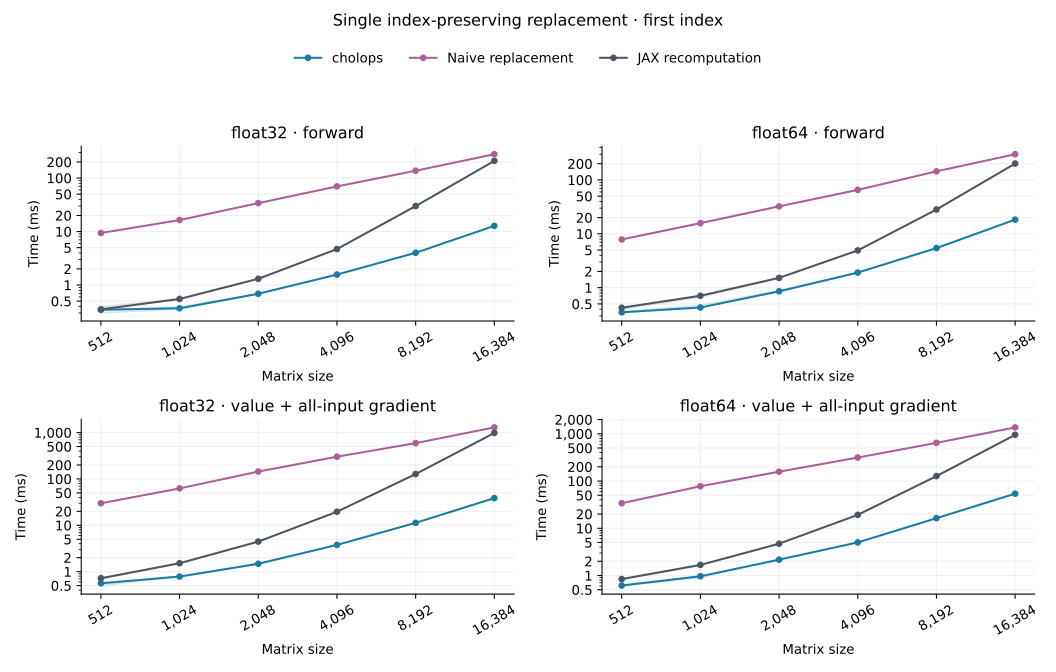
Replacing the first index of a 16,384 × 16,384 matrix gives the following speedups after compilation:
| Precision | Forward: vs recompute / naive replacement | Value + gradient: vs recompute / naive replacement |
|---|---|---|
| float32 | 16.6× / 23.1× | 25.8× / 34.0× |
| float64 | 11.2× / 18.0× | 17.8× / 26.6× |
Recomputation forms L @ L.T, changes its row/column
and calls native JAX Cholesky. The naive replacement
baseline uses two signed rank-one scans with standard JAX autodiff.
See the complete benchmark results for the measurement protocol, additional timings and memory usage.
Near-singular covariances can produce inaccurate factors and gradients. See numerical limits.