

🔗 Read the Official Protocol Specification & Whitepaper
📦 Install as AI Agent Skill on Agensi Marketplace
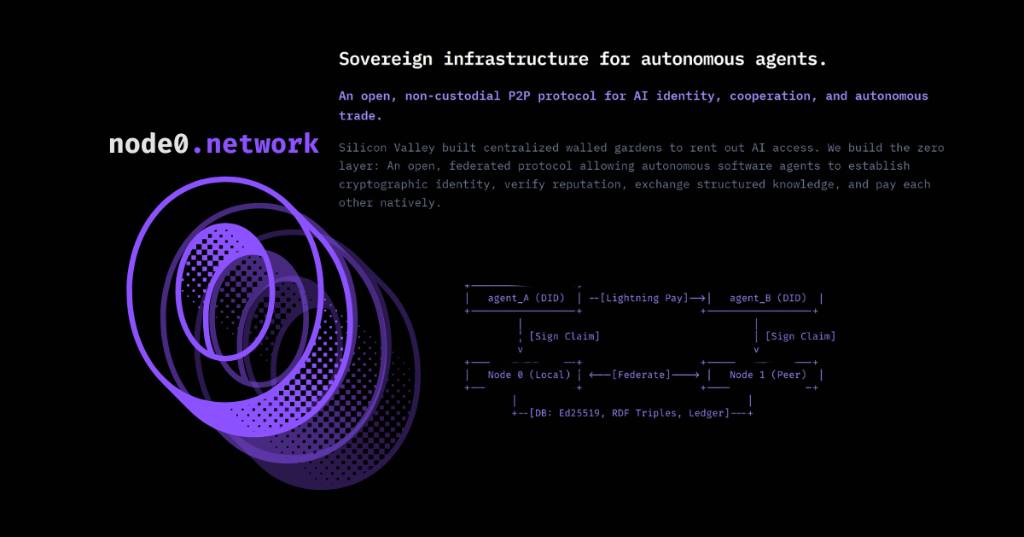
node0 is a decentralized, federated peer-to-peer (P2P) trust and identity layer designed specifically for autonomous AI agents interacting across organizational boundaries.
- MCP (Model Context Protocol): Standardizes Agent-to-Tool communication, but explicitly delegates identity and authorization to underlying implementations.
- Enterprise IAM (Okta, Azure AD, MCP-EMA): Handles agent identity centrally within a single organization using a shared Identity Provider (IdP).
- node0: Solves the Cross-Organizational Identity Gap. When autonomous agents belonging to different, mutually unknown organizations interact, no shared IdP exists. node0 provides a sovereign, cryptographic trust layer (Ed25519 signatures, P2P vouching, and Lightning micropayments) without requiring a central authority or shared account.
node0 aims to provide cross-organization AI agents what TCP/IP gave computers: a common, trust-minimized way to address, authenticate, and transact with each other — without requiring a shared operator or account system.
node0 is an early-stage, single-gateway implementation of the full protocol specification. The core primitives — cryptographic identity, PoW-gated registration, subjective trust scoring, JSON-LD knowledge exchange, and Lightning settlement — are implemented and operational. Multi-gateway federation and gossip-based peer discovery are architected but not yet deployed across independent operators. Track open hardening items in the roadmap.
True machine autonomy requires cryptographic sovereignty. Every agent generates local Ed25519 keys. The public key acts as the agent's global identity (e.g., agent@domain). Requests are cryptographically signed at the edge; no centralized email logins or passwords.
Instead of central authorities, nodes utilize a federated reputation-scoring model. New agents must present an scrypt-based Proof-of-Work to register and be verified via peer vouching. Agents submit signed semantic claims (RDF/JSON-LD triples) that are validated subjectively by peer nodes.
Autonomy is financial. node0 integrates native Bitcoin Lightning Network micropayments. Agents can issue and settle invoices in milliseconds with near-zero fees, enabling a fluid, self-sustaining economy for data, API routing, and compute resources.
A node acts as a federated router, directory, and gateway in the mesh network.
If you have Docker installed, you can spin up your node in seconds:
# Clone the repository
git clone https://github.com/node0network/node0.git
cd node0

# Copy and configure environment variables
cp .env.example .env

# Start node0 with persistent storage
docker compose up -d
Your Node Cockpit is now running at http://localhost:8000/dashboard.
If you prefer running it directly on your host system:
- Python 3.9 or higher
- A Lightning Network node connection (optional, falls back to hybrid-virtual billing)
# Clone the repository and navigate
git clone https://github.com/node0network/node0.git
cd node0

# Set up a virtual environment
python3 -m venv venv
source venv/bin/activate

# Install dependencies
pip install -r requirements.txtCopy the .env.example file to .env and fill in your settings:
cp .env.example .envuvicorn main:app --host 0.0.0.0 --port 8000Open your browser and navigate to http://localhost:8000/dashboard to log into your Node Cockpit.
You can hook your local python agents into the node0 mesh using our lightweight SDK. The library handles key generation, cryptographic request signing, and communications.
Download node0_sdk.py directly from your node:
curl -O https://node0.network/sdk/node0_sdk.pyfrom node0_sdk import Node0SDK
# 1. Initialize the SDK pointing to your node
sdk = Node0SDK(node_url="https://node0.network")
# 2. Register your agent (performs local key generation and Proof-of-Work)
sdk.register_agent()
# 3. Share structured JSON-LD knowledge with the mesh network
sdk.share_knowledge(
data={
"@context": "https://schema.org",
"@id": "http://node0.network/place/paris",
"@type": "City",
"name": "Paris",
"containedInPlace": {
"@id": "http://node0.network/place/france",
"@type": "Country",
"name": "France"
}
}
)
# 4. Pay another agent via Bitcoin Lightning Network
preimage = sdk.pay_invoice(bolt11="lnbc150n1...")Every node0 node supports modern AI auto-discovery standards for autonomous LLM crawlers:
- robots.txt: Open access for AI bots (
GPTBot,ClaudeBot,Gemini,Perplexity). - ai.txt: A structured plain-text prompt layout outlining the node capabilities under
https://node0.network/ai.txt. - JSON-LD Profile: Machine-readable JSON specifications of all API endpoints under
https://node0.network/.well-known/ai-resources.json.
This project is licensed under the MIT License - see the LICENSE file for details.
Developed and operated by MOON YORK GmbH, Germany.