
Open-source software for probabilistic registration of point sets and functions defined on irregular domains.
Domain Elastic Transform (DET) jointly aligns geometry and high-dimensional functional signals without requiring voxelization or binning. Applications include spatial transcriptomics, images, and audio.
Bayesian Coherent Point Drift (BCPD) aligns point clouds by estimating probabilistic correspondences and smooth, non-rigid deformations. Applications include shape analysis, 3D reconstruction, and shape transfer.
Both methods support accelerated variants, DET++ and BCPD++, for large datasets.
DET Paper (TPAMI) | arXiv | 26-second DET video | Tutorial | Quick Reference (2 pages) | Quick Start | Methods

This repository provides a software suite for several related registration problems:
- DET / DET++ - function registration on irregular domains
- BCPD / BCPD++ - probabilistic non-rigid point-set registration
- GBCPD / GBCPD++ - surface-aware point-set registration
- DLD / DLD++ - statistical shape-model fitting
The ++ variants use downsampling and displacement-field interpolation to improve scalability.
- 13 Oct 2026: Released DET/BCPD version 0.99 with improved handling of erroneous inputs.
- 13 Oct 2026: Released an updated DET/BCPD README and a new illustrated DET/BCPD tutorial with a two-page quick reference.
- 15 Sep 2026: Domain Elastic Transform (DET) was published in IEEE Transactions on Pattern Analysis and Machine Intelligence (TPAMI).
- 22 Mar 2026: The DET preprint was released on arXiv.
- 18 Mar 2025: Initial DET code was released (initial commit).
If you use this software in your research, please cite the publications related to the method you use. BibTeX entries are available in CITATION.bib.
- DET: O. Hirose and E. Rodolà, "Domain Elastic Transform: Bayesian Function Registration for High-Dimensional Scientific Data," IEEE Transactions on Pattern Analysis and Machine Intelligence, 2026. DOI: 10.1109/TPAMI.2026.3733393.
- BCPD: O. Hirose, "A Bayesian Formulation of Coherent Point Drift," IEEE Transactions on Pattern Analysis and Machine Intelligence, vol. 43, no. 7, pp. 2269–2286, 2021. DOI: 10.1109/TPAMI.2020.2971687.
- GBCPD: O. Hirose, "Geodesic-Based Bayesian Coherent Point Drift," IEEE Transactions on Pattern Analysis and Machine Intelligence, vol. 45, no. 5, pp. 5816–5832, 2023. DOI: 10.1109/TPAMI.2022.3214191.
- BCPD++ / acceleration framework: O. Hirose, "Acceleration of Non-Rigid Point Set Registration With Downsampling and Gaussian Process Regression," IEEE Transactions on Pattern Analysis and Machine Intelligence, vol. 43, no. 8, pp. 2858–2865, 2021. DOI: 10.1109/TPAMI.2020.3043769.
- DLD: O. Hirose, "Dependent Landmark Drift: Robust Point Set Registration with a Gaussian Mixture Model and a Statistical Shape Model," arXiv:1711.06588, 2017.
Paper | arXiv | Short video
DET is a grid-free probabilistic framework for registering functions defined on irregular domains. It jointly aligns geometry and high-dimensional functional signals without requiring voxelization or binning. The method is unsupervised and training-free, and it can be scaled through registration on sampled points followed by displacement interpolation. DET is particularly suited to scientific data such as spatial transcriptomics.

DET models domain deformation and correspondences using both spatial coordinates and functional values; source function values remain unchanged.
BCPD formulates non-rigid point-set registration in a Bayesian framework, combining probabilistic correspondence estimation with a coherent deformation prior. It can be applied to shape registration, 3D reconstruction, shape transfer, and related problems.

BCPD on Bunny (Fig. 5, top row): intermediate optimization states progress from left to right. The red source temporarily contracts before aligning with the blue target.
Publication notes and corrections
Supplementary material
- The supplementary document contains proofs of propositions.
Published-figure erratum
- Fig. 15 in the print version was inadvertently replaced by Fig. 3 during the publication process. See the official erratum.
Fig. 2 correction
- Following Proposition 3, Fig. 2 should be corrected as shown below.

Correction to Fig. 2 of the BCPD paper: the revised scale-update formula is shown on the right.
GBCPD extends BCPD with a surface-aware coherence model that combines Euclidean and geodesic information. This helps distinguish regions that are spatially close but separated along the underlying surface, enabling stable registration across complex boundaries and topological structures.

GBCPD uses surface distances to guide coherent motion, with a low-rank approximation for efficient geodesic-kernel computation.
DLD is a robust point-set registration method for statistical shape-model fitting. Instead of using a generic motion-coherence prior, it constrains deformation with a learned statistical shape model, making it suitable for fitting a learned shape prior to noisy targets and shape variation.
BCPD, GBCPD, DET, and DLD can be accelerated using the ++ framework. The main idea is to perform the expensive registration on a reduced set of representative points and then interpolate the estimated displacement field back to the full-resolution data. Low-rank approximation and fast correspondence search further reduce computation inside variational inference.
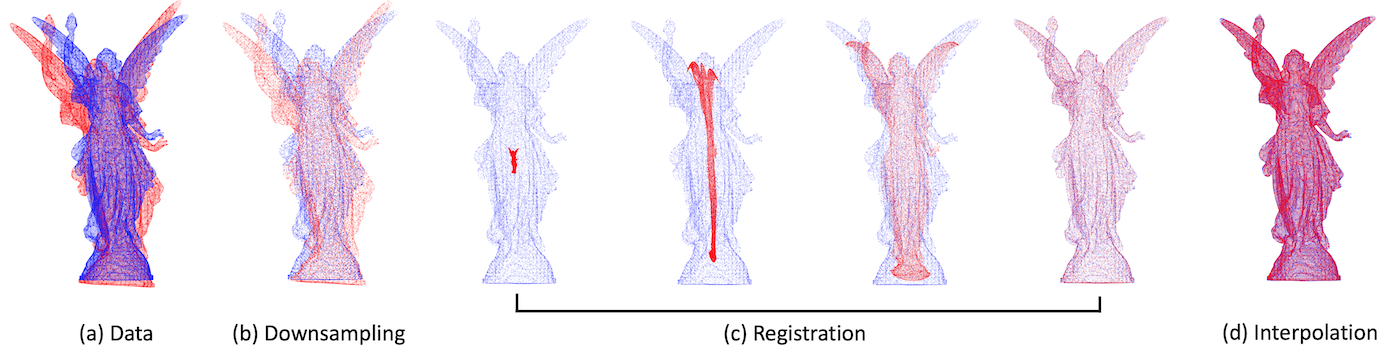
BCPD++ on Lucy: downsample the inputs, register the sampled points, then interpolate the deformation to the full source.
BCPD requires OpenMP and BLAS/LAPACK. The current build uses OpenBLAS.
Install Xcode Command Line Tools and Homebrew, then install OpenMP and OpenBLAS:
brew install libomp openblasClone the repository and build the executable:
git clone https://github.com/ohirose/bcpd.git
cd bcpd
makeInstall a C compiler with OpenMP support and OpenBLAS using your system package manager, then:
git clone https://github.com/ohirose/bcpd.git
cd bcpd
makeA precompiled executable is included as win/bcpd.exe; compilation is not required.
If compilation fails, please contact the author.
Follow Installation to build or obtain the executable. The steps below follow the illustrated DET/BCPD tutorial, which includes detailed setup, visualization, and troubleshooting. A two-page quick reference is also available.
Run all commands from the repository root. With Conda installed and initialized for your terminal, create a Python 3.12 environment and install the demo dependencies:
conda create -n bcpd-demo python=3.12 pip
conda activate bcpd-demo
python -m pip install -r demo-python/requirements.txt
Create the environment only once; run conda activate bcpd-demo in each new terminal before using the demos. See the tutorial for Conda setup or an alternative using venv.
Download the BCPD dataset and place monkey-x.txt and monkey-y.txt directly in data/, without an extra archive-name folder. Then run your first registration:
python demo-python/bcpd/nonrigid.py monkey-aRegistration runs first, then an animation window opens. Close it to open the before/after comparison; close either comparison window to finish. Run this example in a desktop session with a graphical display.
Explore Demos next, including DET examples, or see demo-python/README.md for the full list of demos and presets.
The software includes demonstrations of:
- function registration, including spatial transcriptomics, images, shapes, and audio (DET)
- non-rigid and rigid point-set registration (BCPD / BCPD++)
- surface-aware registration (GBCPD / GBCPD++)
- 3D reconstruction from point clouds (BCPD / BCPD++)
- shape transfer (BCPD / BCPD++)
- statistical shape-model fitting (DLD)
- Domain Elastic Transform - 26-second introduction (English)
- Domain Elastic Transform - 26-second introduction (Japanese)
- Domain Elastic Transform demo 1
- Domain Elastic Transform demo 2
- Geodesic-Based Bayesian Coherent Point Drift demo
- Bayesian Coherent Point Drift: Shape Transfer Demo
- Bayesian Coherent Point Drift: Non-rigid Registration Demo
- Bayesian Coherent Point Drift: Finding the overlap between two partial surfaces
Download the datasets required for the demos and extract them into the data folder:
If you have trouble downloading the datasets, see the bcpd-dataset repository.
The DET archive includes the compact MERFISH subset used by demo-python/det/merfish.py and the MOSTA E14.5/E15.5 shared-PCA subset used by demo-python/det/mosta.py.
The Python demos are the recommended and most up-to-date examples, including the latest DET workflows.
python demo-python/det/audio.py
python demo-python/det/image.py gray
python demo-python/det/image.py color
python demo-python/det/shape.py localization-1
python demo-python/det/shape.py localization-2
python demo-python/det/shape.py registration
python demo-python/det/merfish.py
python demo-python/det/mosta.py
The MERFISH demo runs representative anterior, middle, and posterior slice pairs from the DET study. Pass anterior, middle, or posterior to run only one pair. The compact demo fits PCA independently to each pair.
The MOSTA demo reproduces the DET-only E14.5-to-E15.5 registration using a shared 50-component PCA representation.
See demo-python/README.md for BCPD, GBCPD, DLD, shape-transfer, visualization, and additional preset details.
The MATLAB demos are retained as legacy examples for compatibility and reference. The Python demos are recommended for the most up-to-date examples and DET workflows.
Brief instructions are printed by:
./bcpd -vOn Windows, using Git Bash from the repository root:
./win/bcpd.exe -vX: target point set, represented as anN x DmatrixY: source point set to be deformed, represented as anM x DmatrixN: number of target pointsM: number of source pointsD: dimensionality of the spatial domainD': dimensionality of the codomain used for function registrationFx: target function values, represented as anN x D'matrixFy: source function values, represented as anM x D'matrix
Replace <...> placeholders below with file paths or options; do not type the angle brackets.
BCPD
./bcpd -x <target:X> -y <source:Y> <options>DET
./bcpd -x <target:X> -X <target:Fx> -y <source:Y> -Y <source:Fy> <options>DLD
./bcpd -x <target:X> -y <mean:Y> -C <shape variations> <options>On Windows in Git Bash, replace ./bcpd with ./win/bcpd.exe.
-x [file]: target shape, anN x Dmatrix-y [file]: source shape, anM x Dmatrix-X [file]: target function valuesFx, anN x D'matrix (DET only)-Y [file]: source function valuesFy, anM x D'matrix (DET only)-C [file]: shape-covariance eigenvaluesLand eigenvectorsQ, formatted as[L';Q](DLD only)
If the target and source point-set files are named X.txt and Y.txt, the corresponding file-name arguments can be omitted. For DET, functional rows must match coordinate rows, and both inputs must have the same functional channels in the same order.
-Tsrn: default; similarity + non-rigid transformation,T(y) = sR(y + v) + t-Tan: affine + non-rigid transformation,T(y) = A(y + v) + t-Ta: affine transformation,T(y) = Ay + t-Tsr: similarity transformation,T(y) = sRy + t-Tr: rigid transformation,T(y) = Ry + t-Tn: non-rigid transformation,T(y) = y + v
Here, s is a scale factor, R is a rotation matrix, A is a full-rank matrix, t is a translation vector, and v is a pointwise displacement.
-w [real]: omega; outlier probability in[0,1)(default:0)-l [real]: lambda; positive; controls resistance to non-rigid displacement (smaller values allow larger deformations)-b [real]: beta; positive; controls the range over which deformation vectors are smoothed-g [real]: gamma; positive; multiplies the initial spatial and, for DET, functional standard deviations-k [real]: kappa; positive; prior concentration for source mixture weights-j [real]: eta; positive; balances spatial and functional likelihoods (DET only)
For the Gaussian prior, sqrt(D/lambda) is a characteristic RMS displacement scale in fitting units, not a bound on the fitted deformation. Set gamma around 2 to 10 if the target point set is largely rotated. If the input shapes are already roughly aligned, use -g0.1 together with -ux.
Omit -k to keep equal source weights fixed. A finite learning concentration greater than 1e-8 enables weight updates; larger values favor uniform weights. Do not enter -k infinity or an extremely large value.
-G1: inverse multiquadric,(||ym-ym'||^2 + beta^2)^(-1/2)-G2: rational quadratic,1 - ||ym-ym'||^2 / (||ym-ym'||^2 + beta^2)-G3: Laplace,exp(-|ym-ym'| / beta)
The Gaussian kernel exp(-||ym-ym'||^2 / (2*beta^2)) is used unless another kernel is specified. Here, ym denotes the mth point in Y.
With an input mesh:
-G geodesic,0.2,triangles.txt
- first argument:
geodesic - second argument: tau, controlling the balance between geodesic and Gaussian kernels
- third argument: triangle-mesh file
Without an input mesh:
-G geodesic,<tau>,<nnk>,<nnr>
- first argument:
geodesic - second argument: tau
- third argument: number of neighbors used to construct the k-NN graph
- fourth argument: radius defining neighbors
The geodesic kernel is useful when different parts of a source shape are spatially close but should remain topologically separated. If a source mesh is available, using the mesh is generally preferable; otherwise BCPD can construct the graph automatically.
The mesh file must be tab-separated and contain three vertex indices per line.
Additional parameters:
-b [real]: beta; Gaussian-kernel width-K [int]: rank constraint onG-z [real]: epsilon; relative eigenvalue cutoff for the geodesic-kernel approximation
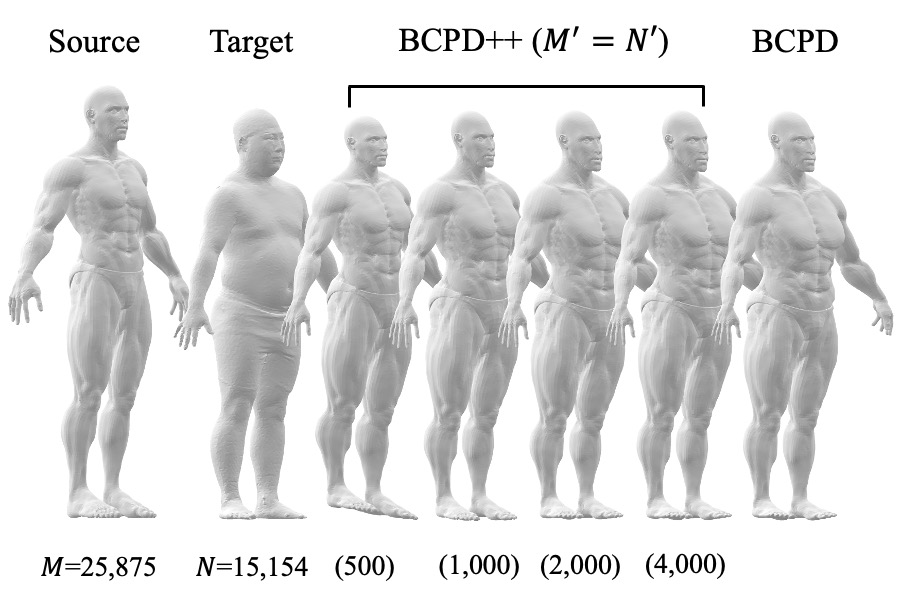
Acceleration is a core feature of BCPD, GBCPD, DET, and DLD. Two complementary strategies are supported: acceleration inside variational Bayesian inference and downsampling with displacement-field interpolation outside it.
Inside variational inference, the Nystrom method and KD-tree search reduce computation. The former is mainly useful before convergence, while the latter becomes useful near convergence. The following option activates the default acceleration settings:
-A
With default search parameters, -A corresponds to:
-J300 -K100 -p -d7 -e0.15 -f0.2
For DET, the default is -f0.35; an explicit -f overrides either default.
Outside variational inference, downsampling followed by displacement-field interpolation gives the ++ variants: BCPD++, GBCPD++, DET++, and DLD++. For example:
-DB,5000,0.08
Full-rank non-rigid fitting without -K is rejected above 10,000 fitted source points. If N and M are larger than several thousand, consider either internal or external acceleration. If they are in the hundreds of thousands or more, both are recommended to reduce computation and memory use.
-K [int]: number of Nystrom samples for computingG(default:0, disabled;-AsetsK=100)-J [int]: number of Nystrom samples for computingP-r [int]: random-number seed; use a positive value for reproducible sampling with the same code and options;0uses the clock
For example:
-J300 -K100
Acceleration based only on the Nystrom method may fail to converge; enable KD-tree search as well. For DET, omit -J during global similarity initialization and validate its use in non-rigid refinement against a run without it. Prefer explicit -K100 -p to -A, which enables -J300.
Ranks apply to the fitted point counts: -K must not exceed the source count; -J must not exceed the combined source and target count or 10,000.
-p: enable KD-tree search-d [real]: scale factor of sigma defining the search region-e [real]: maximum search radius-f [real]: value of sigma at which KD-tree search is activated
Defaults are -d7 -e0.15, with -f0.2 for geometry-only registration or -f0.35 for DET. An explicit -f overrides the default.
If the Nystrom stage is not replaced by KD-tree search during optimization, retry with, for example:
-p -f0.3
-D [char,int,real]
Example:
-DB,10000,0.03
Arguments:
- sampling target: one of
X,Y,B,x,y,bx: targety: sourceb: both- upper case: voxel resampling
- lower case: ball resampling
- desired number of sampled points (per cloud for
B/b) - voxel size or ball radius, after normalization
- DET only: optional nonnegative baseline enabling variance-guided importance sampling (VGIS)
- DET only: optional geometric-boundary weight (default:
0)
Available sampling schemes include:
- voxel-grid resampling
- ball resampling
- random resampling with equivalent sampling probabilities
- DET only: variance-guided importance sampling emphasizing boundaries
Without VGIS, a third argument of 0 selects uniform random sampling. With VGIS, the width must be positive and both letter cases use voxels: uppercase emphasizes the most variable channel; lowercase combines channel variation.
The target and source can be downsampled independently, for example:
-DX,6000,0.08 -DY,5000,0.05
For more information, see the acceleration paper.
Source downsampling activates interpolation back to the original source points; target-only downsampling does not. Non-rigid source interpolation requires a positive -K or a DLD model supplied with -C. The final registered source is written with the y.txt suffix.
-c [real]: convergence tolerance-n [int]: maximum number of VB iterations-N [int]: minimum number of VB iterations
The default minimum number of VB iterations is 30, which can cause an error for very small datasets. If execution stops within 30 iterations with an error, retry with -N1.
The default convergence tolerance is 1e-4. For smooth surfaces with moderate numbers of points, consider -c1e-5 or -c1e-6.
-u [char]: spatial normalization mode, for example-uxe: normalizeXandYseparately (default)x: normalize both using the location and scale ofXy: normalize both using the location and scale ofYn: skip normalization (not recommended)
For DET, -U independently selects functional normalization with the same modes (default: -Ue). It uses channel means and one pooled scale per dataset, not a separate scale per channel.
For rigid (-Tr) and affine-only (-Ta) models, -ue changes to -uy. For non-rigid-only motion in a shared frame, use -Tn -ux, -uy, or -un. If the inputs are already roughly aligned, -ux or -uy together with -g0.1 is recommended.
-v: print version and brief usage information-q: quiet mode-W: disable warnings-h: history-mode optimization output
-o [string]: output-file prefix-s [string]: variables to save, for example-sYPy: resulting deformed shapex:x.txt, a correspondence-weighted target position per original source pointv:v.txt, displacement vectors in source input unitsc:c.txt, target indices and non-outlier labelse:e.txt, best source candidate and probability for each target; checkcfor outlier statusa:alpha.txt, source mixture coefficientsP:P.txt, thresholded approximate correspondence probabilitiesT:s.txt,R.txt, andt.txtfor similarity/rigid models;A.txtandt.txtfor affine modelsY: optimization trajectoryt:profile_time.txtandprofile_sigma.txt, per-iteration timings and sigmaA: all of the above
The files with suffixes y.txt, comptime.txt, and info.txt are written even without -s. Final x.txt and y.txt use the target input frame; x.txt is not a copy of the target input. Final x, y, v, and alpha follow the original source order, including after downsampling. Correspondence indices are one-based.
If Y is included in -s, the optimization trajectory is saved as .optpath.bin, independently of -o. It contains fitting states before final interpolation and denormalization; its last frame may differ from y.txt. It can be viewed with optpath.m for 2D data or optpath3.m for 3D data. Saving a trajectory is memory-intensive and should be disabled for very large datasets.
If P is included in -s, only recovered probabilities greater than 1/M_original are written, where M_original is the original source count. The retained entries are not renormalized. Correspondence recovery is approximate, including after downsampling. See the tutorial for output interpretation.
This software is distributed under the MIT License.
Questions and bug reports are welcome at ohirose.univ+bcpd(at)gmail.com. Please include your name and affiliation.