







Maintainer of Yuvomi, the self-hosted family planner. Teacher of computer science, maths and social sciences in Germany, working on AI literacy and digital sovereignty in education.
I build software that a household can run, own and leave: its data stays on its own server, nothing tracks it, and nothing locks it in. Open standards, MIT license, no cloud account with anyone.
yuvomi.cloud · LinkedIn · Sponsor
Tasks, calendar, budget, meals, shopping, health and documents for a family, in one PWA on a home server or NAS.


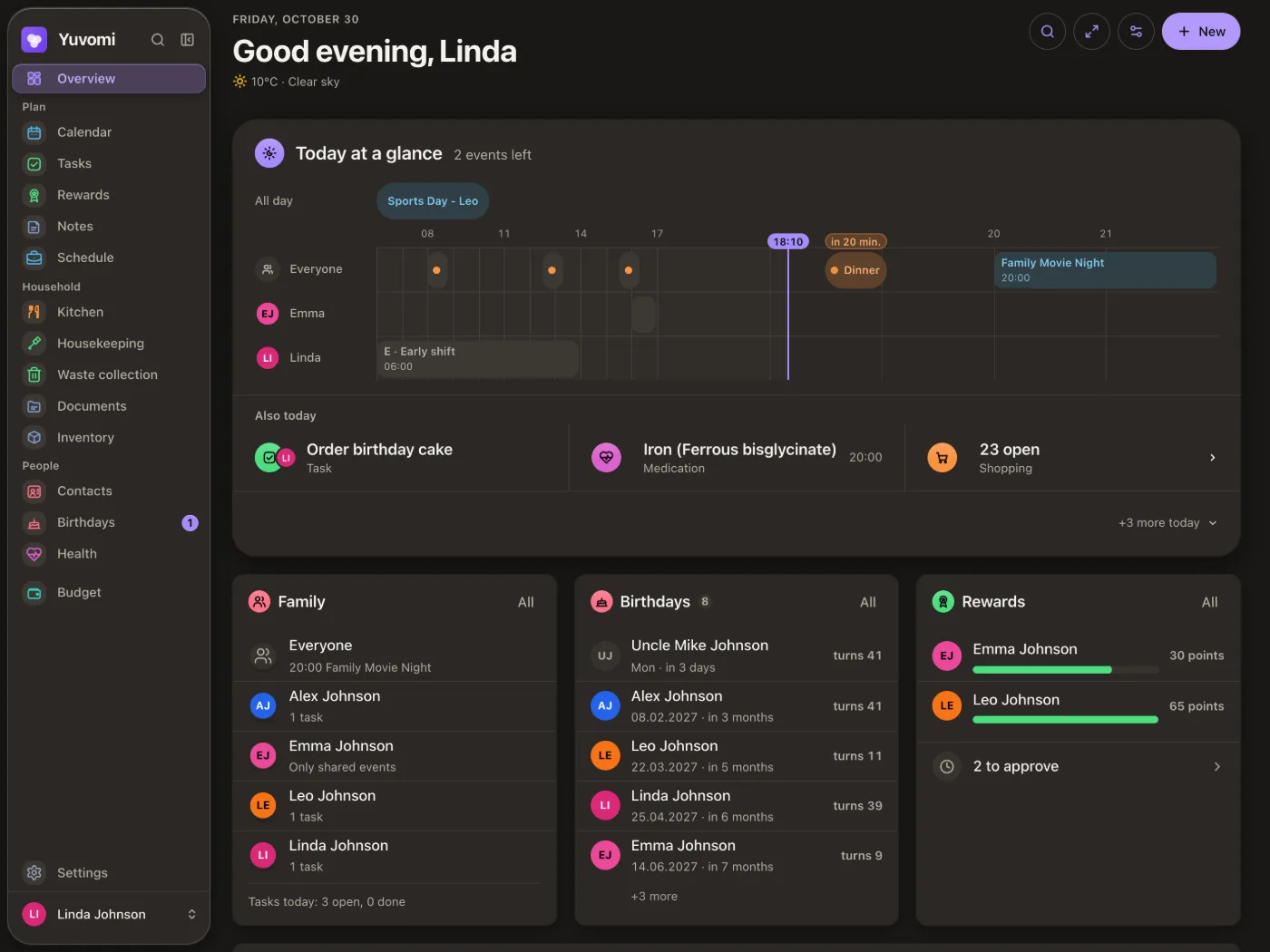
- In development since March 2026 with Node.js, Express, SQLite and plain JavaScript. 20 modules, translated into 27 languages, runs on amd64 and arm64 in 256 MB of RAM. I'm the main maintainer; more than 40 people have contributed so far.
- Installs from the app catalogs of Umbrel, TrueNAS SCALE and Unraid, with the Proxmox community script, as a Home Assistant app (started by olli-dot-dev, now maintained here), as a YunoHost package (not in the YunoHost catalog yet), or with Docker or Podman. Every release opens an update pull request for the Umbrel app store automatically.
- Covered by Caschys Blog, mobiFlip and LinuxLinks; setup guides by mariushosting and deployn on YouTube.
- Others build on it: a community handbook by Kyrodan.
- Few moving parts, on purpose. No frontend framework, no bundler, no CDN; third-party code is vendored by hand with its license. Fewer dependencies to update, audit and trust, and less to break for a family that updates once a year.
- Rules live in tests. The hard constraints - no framework imports, no
innerHTML, every UI string in every language, database migrations that only ever grow at the end - fail the build instead of relying on good intentions. - A fix counts when a test proves it. Every bug fix comes with a test that fails against the code before the fix.
- AI agents, openly. Much of the code is drafted with AI coding agents, and two of them, Claude Code and Codex, review pull requests independently of each other. I set the direction, the constraints and the tests they have to pass, and I answer for what ships. How Yuvomi uses AI
I teach computer science, mathematics and social sciences at a comprehensive school in Dortmund. To me, AI literacy is computer science education: if you don't understand how models, data and infrastructure fit together, you learn to operate tools, not to think for yourself. At school I rebuilt the lower-secondary computer science curriculum, headed the department and designed in-house teacher training on large language models.
Yuvomi is where I put that into practice: AI agents draft much of the code, a human sets the constraints and answers for what ships, and the data stays with the people who create it.
Research interests: AI literacy and computer science education · digital sovereignty in educational institutions · teacher education on AI
Teaching also shapes how I write documentation, error messages and issue replies: for the person who has to understand them, not for the one who already does.
- Questions about Yuvomi: Discussions
- Press, talks, research collaboration: info@yuvomi.cloud or LinkedIn
- Support the work: GitHub Sponsors