

Interactive ER diagrams from QuickDBD text, DBML or a dbt project, readable at 200+ tables


Docs · Live demos · Quickstart · PyPI · VS Code Marketplace · Open VSX
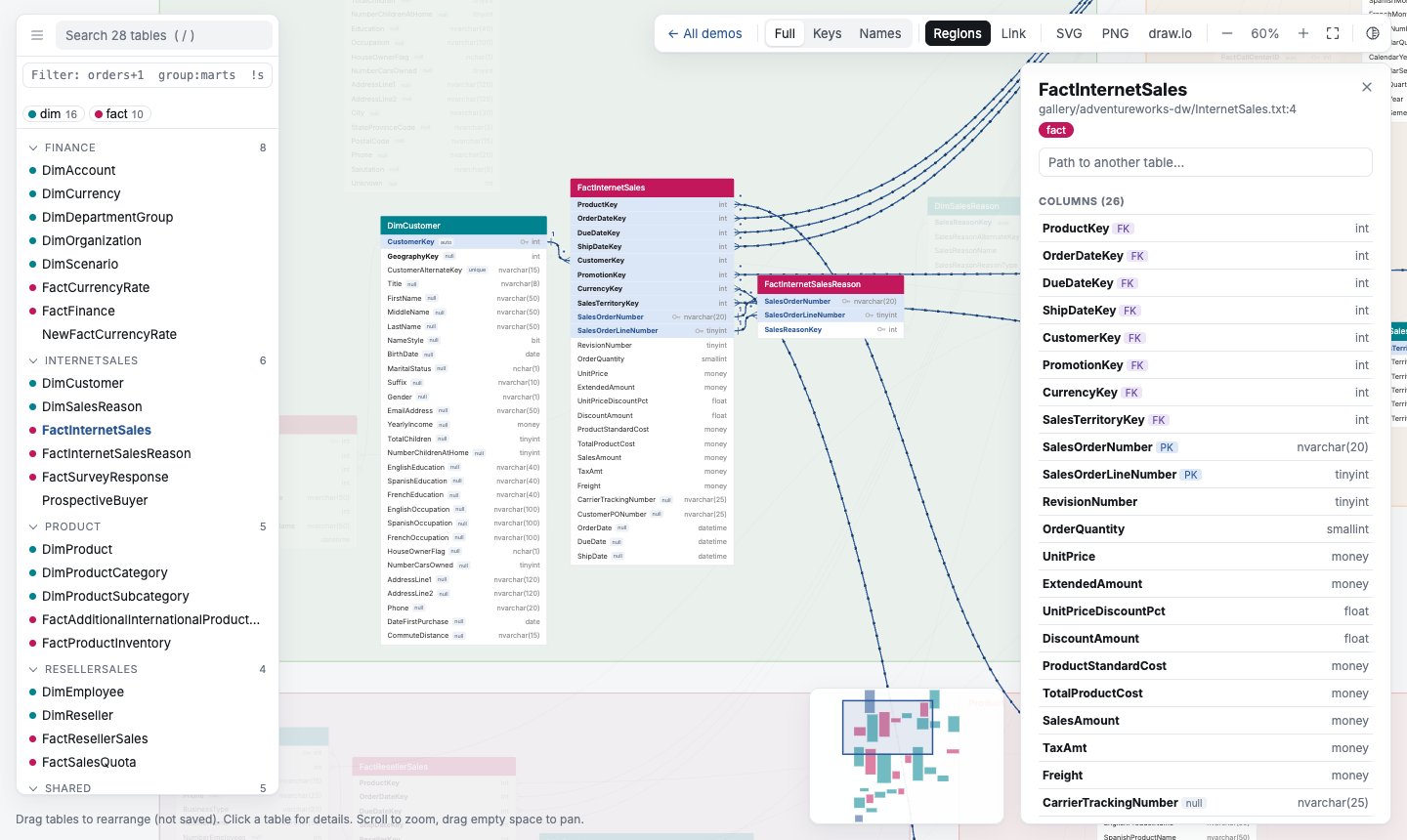
AdventureWorks DW (28 tables), a star schema in five regions, built by qdbd. Try it live →
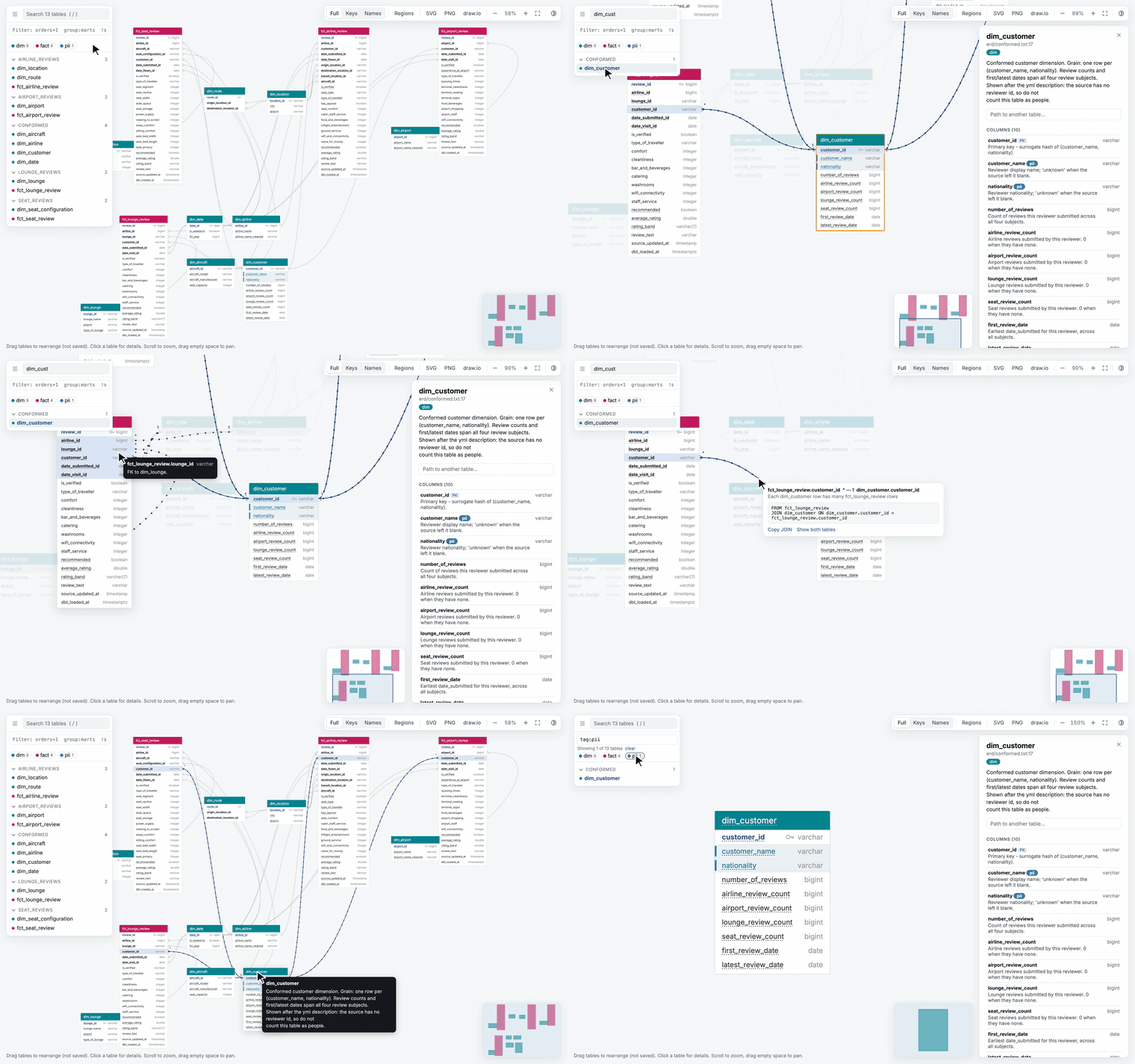
Watch the full 75-second demo →
qdbd is a command-line tool that turns a database schema written as text into an interactive ER diagram.
- Diagrams drawn by hand look good, but they live outside the repo and go stale the first time the schema changes.
- Generated diagrams stay current, but most become unreadable past a few dozen tables.
With qdbd the schema is a plain-text file in git, written in QuickDBD's syntax or DBML (dbdiagram.io's), or generated from a dbt project. qdbd checks it, lays it out, and builds one self-contained HTML page you can search, filter, click through and share.
You get a diagram that lives next to your code and stays usable at hundreds of tables.
qdbd is not affiliated with QuickDBD or dbdiagram.io. It reads the same text syntaxes, so schemas copy back and forth, and qdbd convert turns one syntax into the other.
- QuickDBD-compatible: the parser mirrors QuickDBD's own, error messages included. A file that passes
qdbd check --strictpastes into QuickDBD unchanged. - dbt import:
qdbd import dbtreadsmanifest.json. Primary keys come fromunique+not_nulltests or constraints, relationships fromrelationshipstests, and--infer-fksfills the gaps from column names. - Readable at 200+ tables: automatic layout, search, dbt-style selectors (
+orders+1,group:marts,tag:fact), shaded regions per file, collapsed views and a minimap. - Review changes in pull requests:
qdbd diffreports what a branch changed, the GitHub Action posts it as a PR comment, and--diff-basecolours the changes in the diagram. To propose a column change, tag the column# @tag: addedor# @tag: removedand it's drawn green or red (column tags). - VS Code extension: highlighting, errors as you type, outline, F12 across files, and the diagram beside the editor, following your cursor, or in your browser on localhost. Export, share, compare with git, convert to and from DBML, and dbt import from the sidebar or the Command Palette, with no terminal: it installs the CLI itself. Get it from the VS Code Marketplace or, for Cursor, Windsurf and VSCodium, Open VSX (docs).
- AI agents:
qdbd mcpgives Claude, Copilot and Cursor your schema as tools: tables and columns, join paths as SQL (composite keys included), checks for their edits and diffs againstmain(docs). - One schema, many outputs: an HTML page, PNG, SVG, editable draw.io, or a shareable link. Installs with pip: no Node, Graphviz or browser needed.
Every demo is a single HTML page written by qdbd build, from a QuickDBD schema or a dbt manifest.
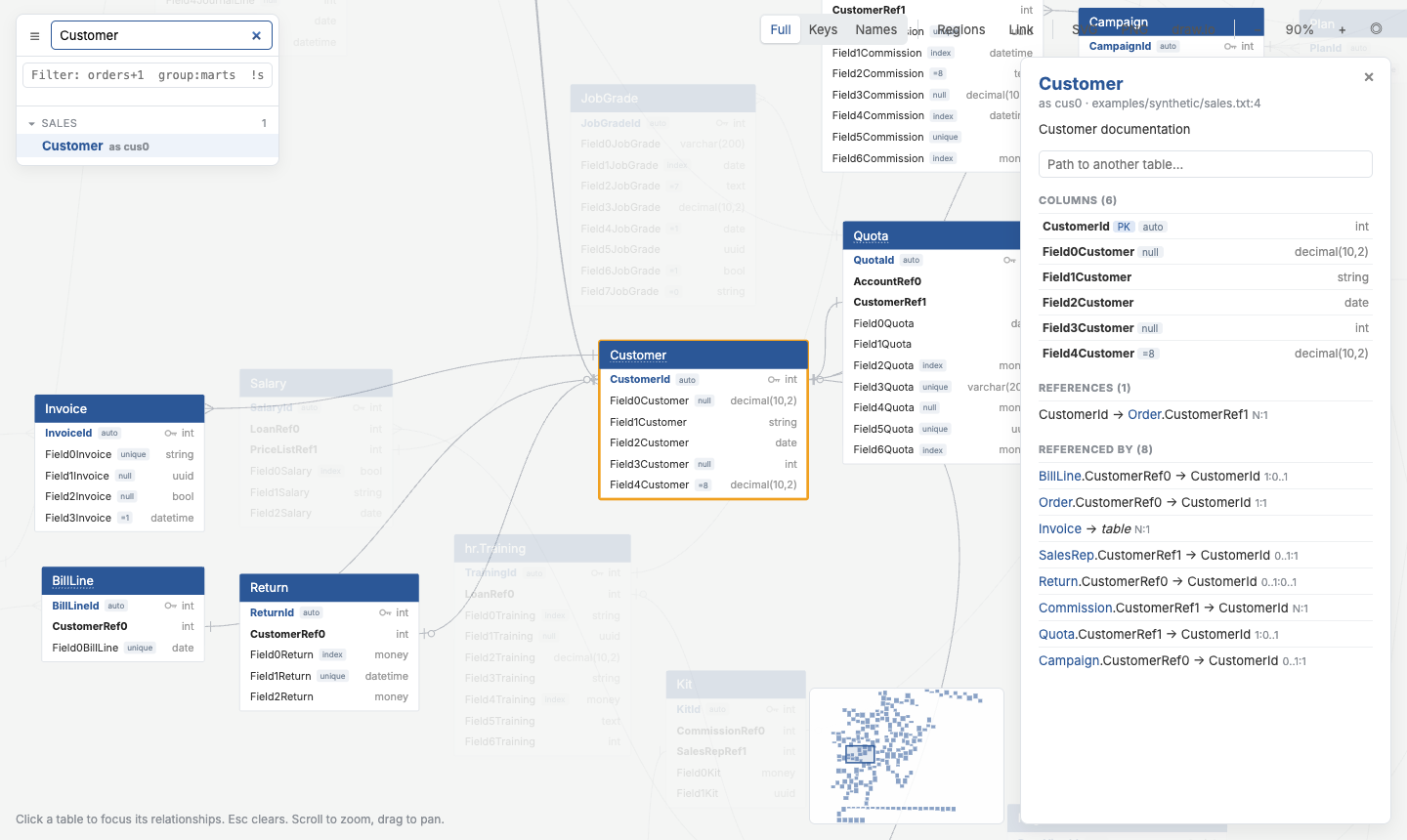
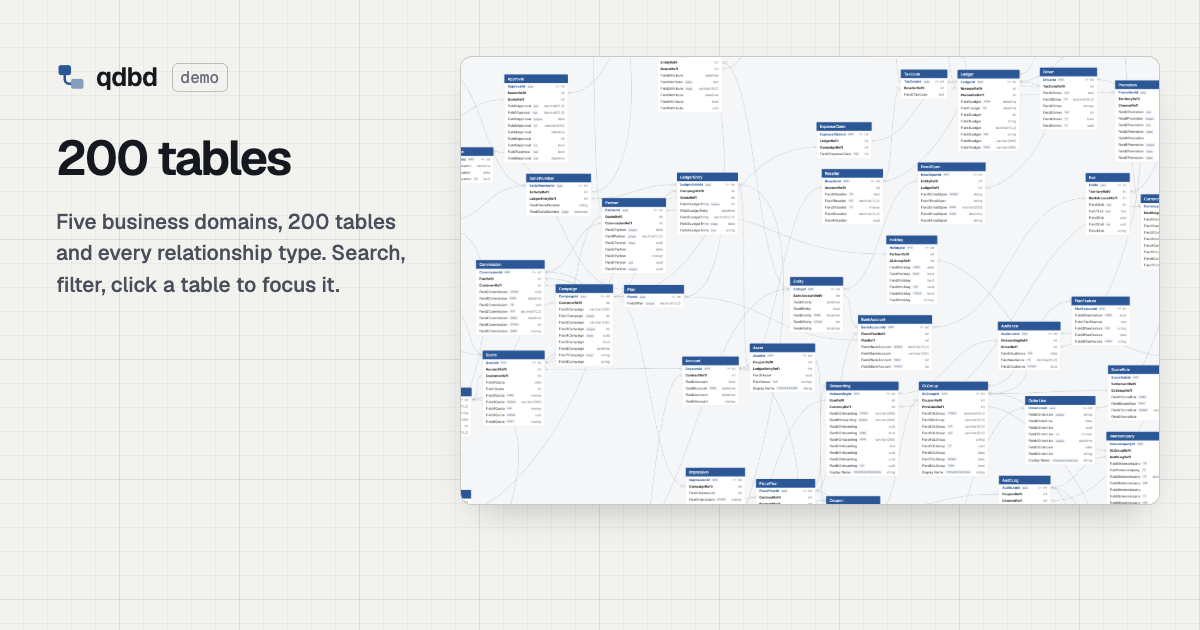 200 tables Five business domains, 200 tables and every relationship type. Search, filter, click a table to focus it. |
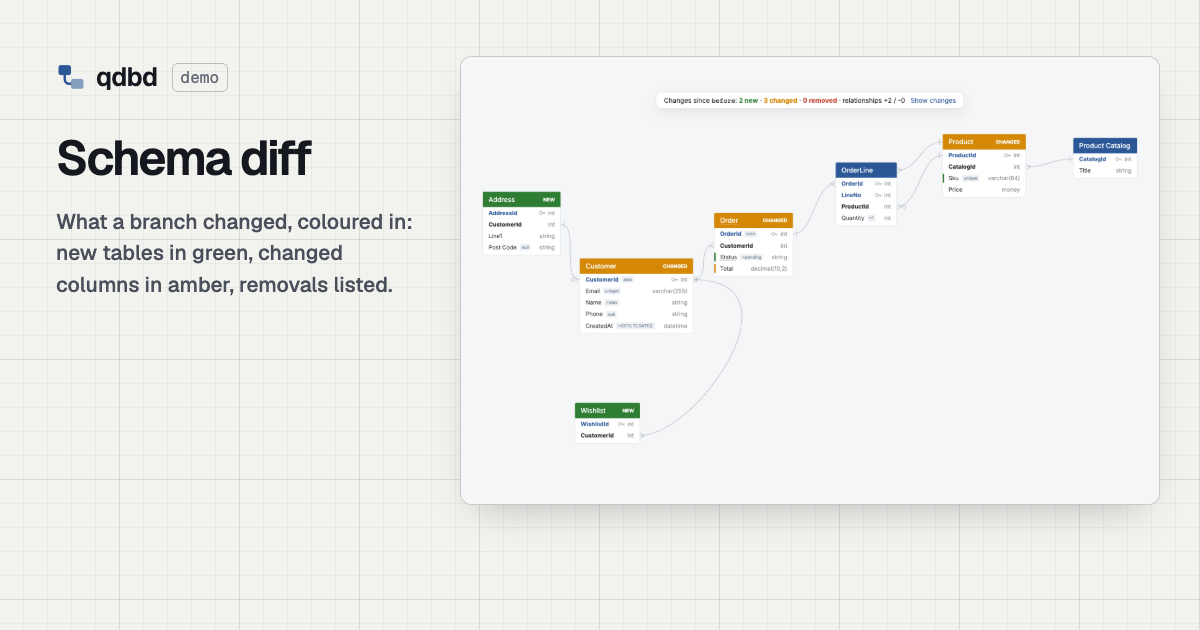 Schema diff What a branch changed, coloured in: new tables in green, changed columns in amber, removals listed. |
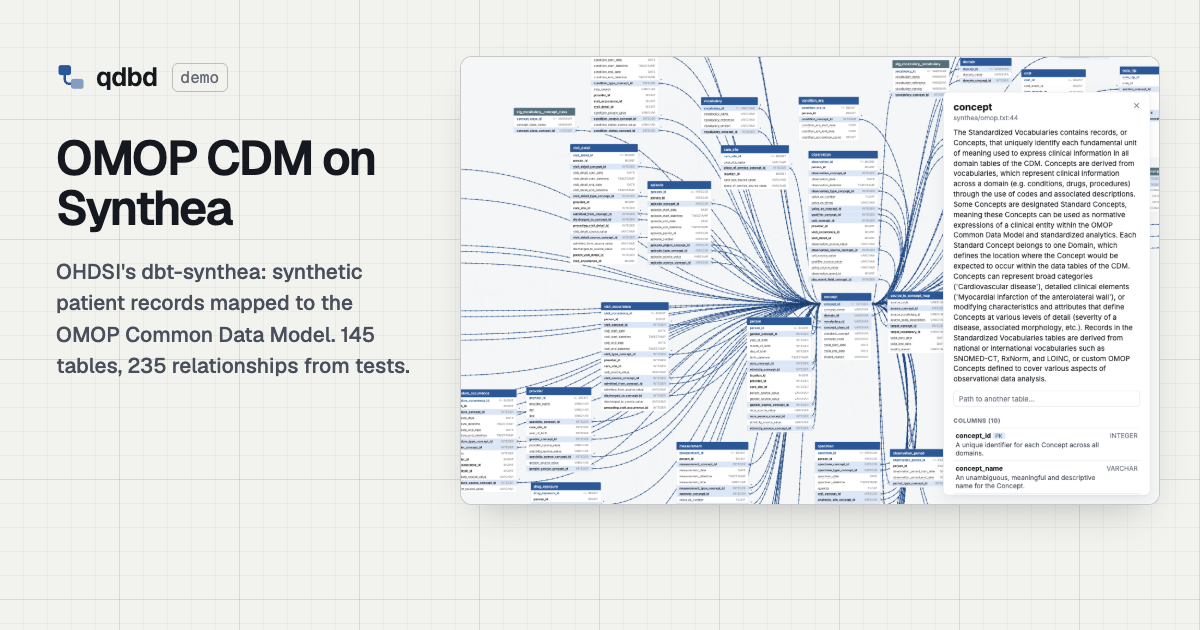 OMOP CDM on Synthea OHDSI's dbt-synthea: synthetic patient records mapped to the OMOP Common Data Model. 145 tables, 235 relationships from tests. |
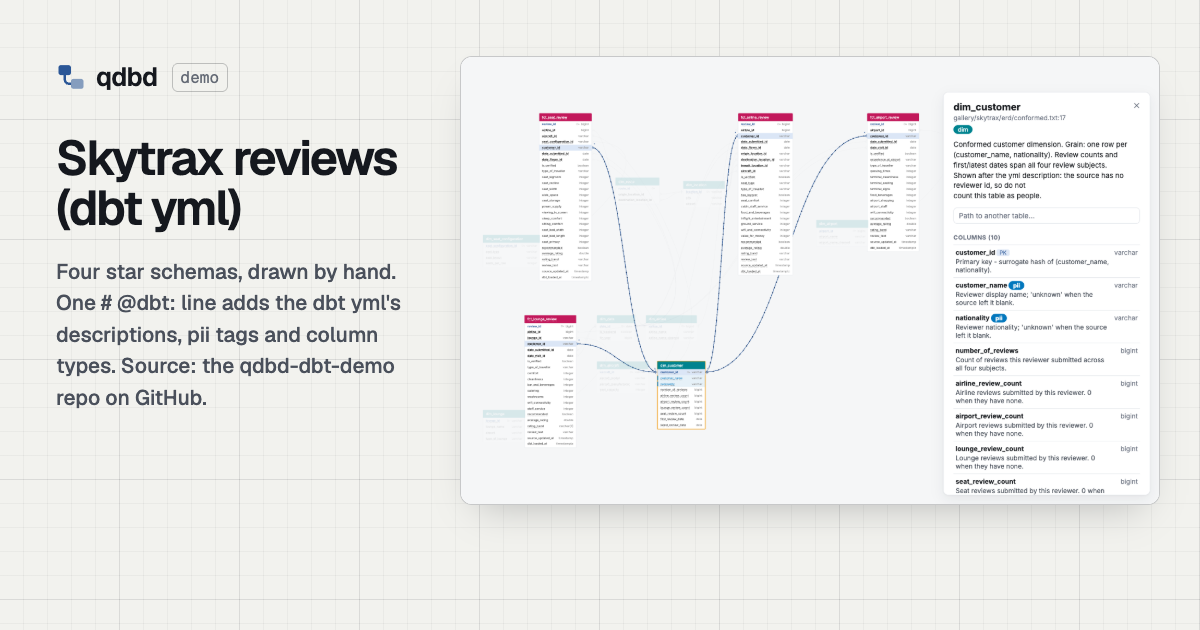 Skytrax reviews (dbt yml) Four star schemas, drawn by hand. One # @dbt: line adds the dbt yml's descriptions, pii tags and column types. Source: the qdbd-dbt-demo repo on GitHub. |
curl -O https://raw.githubusercontent.com/MarkPhamm/quickdbd-cli/main/examples/quickdbd-sample.txt
uvx --from quickdbd-cli qdbd serve quickdbd-sample.txt
A browser tab opens with the diagram and an editor. Change the text and the diagram reloads; drag tables to arrange them.
pipx install quickdbd-cli # or: pip install quickdbd-cli / uv tool install quickdbd-cliPython 3.11+. See Install for other options.
Save this as schema.txt, or paste in a schema from QuickDBD unchanged:
Customer
-
CustomerId PK int
Email string UNIQUE

Order as o
----
OrderId PK int
CustomerId int FK >- Customer.CustomerId
Total decimal(10,2)
A table is a name, a line of dashes, then one column per line. FK >- Customer.CustomerId means many orders to one customer. The full syntax is in Schema Syntax. DBML from dbdiagram.io works as it is, as .dbml or .txt (DBML).
For a dbt project, generate the schema instead:
dbt docs generate                                  # writes target/manifest.json + catalog.json
qdbd import dbt target/ -o erd/ --infer-fks # one .txt file per dbt folderqdbd serve schema.txtEdit in the browser or in your own editor; the diagram reloads on save. Dragged positions are saved to schema.layout.json, which you commit next to the schema.
In VS Code (or Cursor), the extension does the same inside the editor, with errors as you type and the diagram following your cursor. Search QuickDBD in the Extensions view: it's on the VS Code Marketplace and Open VSX.
qdbd build schema.txt -o schema.html      # one self-contained page
qdbd export schema.txt -o schema.png      # or .svg, .drawio
QDBD_ALLOW_SHARE=1 qdbd share schema.txt # a link via a GitHub gist: off by default, see the disclaimerThe GitHub Action checks the schema and builds the diagram. On pull requests it also posts one schema-diff comment, updated on every push.
# .github/workflows/erd.yml
name: ERD
on: [pull_request, push]
jobs:
  erd:
    runs-on: ubuntu-latest
    permissions: { contents: read, pull-requests: write }
    steps:
      - uses: actions/checkout@v4
      - uses: MarkPhamm/quickdbd-cli@v0.6.2
        with:
          path: erd/                  # schema file(s) or folder(s)
          output: site/index.html
dbt projects, GitHub Pages, pre-commit and GitLab CI are covered in CI and Automation.
dbt project ──qdbd import dbt──┐
                               ├──▶ schema/*.txt, *.dbml   (QuickDBD syntax or DBML, in git)
hand-written / pasted ─────────┘           │
                                           ├──▶ qdbd check   validation, QuickDBD's error messages  ──▶ CI gate
                                           ├──▶ qdbd serve   live editor, drag to arrange           ──▶ schema.layout.json
                                           ├──▶ qdbd build   interactive HTML                       ──▶ GitHub Pages, artifacts
                                           ├──▶ qdbd diff    what changed vs main                   ──▶ PR comment
                                           ├──▶ qdbd export  PNG · SVG · draw.io                    ──▶ docs, slides, wikis
                                           └──▶ qdbd mcp     schema tools for AI agents             ──▶ Claude, Copilot, Cursor
- The parser follows QuickDBD's own parser step by step, so the same text gives the same tables and the same errors.
- The layout comes from ELK. Positions you drag are saved by table name, and new tables are placed next to the tables they relate to, so the diagram doesn't reshuffle.
- One renderer draws both the page and the images. It runs in the browser, and inside an embedded JavaScript engine for CLI exports, so a PNG always matches the page.
- Builds are deterministic: no timestamps or randomness, so the output only changes when the schema does.
1. The schema, a text file in your repo:
# Every order belongs to one customer.
Order as o
----
OrderId PK int IDENTITY
CustomerId int FK >- Customer.CustomerId
Status string="pending" # current fulfilment state
2. The command:
qdbd build schema/ -o erd.html3. The page: click a table for its columns, comments and relationships, or type another table's name to get the join path as SQL.
| qdbd | QuickDBD | |
|---|---|---|
| Text syntax | QuickDBD's or DBML | QuickDBD's |
| Tables per diagram | no limit | 10 on the free plan |
| Where it runs | your terminal and CI; the result is a static HTML file | the QuickDBD web app |
| Where the schema lives | .txt / .dbml files in your git repo |
the web app |
| dbt import, schema diffs, PR comments | ✅ | — |
Use QuickDBD's editor when you want it: a schema that passes qdbd check --strict pastes in unchanged.
Do I need a QuickDBD account? No. qdbd only borrows the text syntax.
Does qdbd connect to my database?
No. It reads .txt / .dbml schema files or a dbt manifest.json. Nothing connects to a warehouse.
Does my schema leave my machine?
Only if you turn sharing on (QDBD_ALLOW_SHARE=1, or quickdbd.allowSharing in VS Code) and run qdbd share, which uploads the page to a GitHub gist in your account (secret by default), publish it yourself (a tunnel, GitHub Pages), or connect an AI agent through qdbd mcp, whose answers go to your AI provider. qdbd serve loads its code editor from a CDN; the built pages load nothing.
How big can a diagram get?
The demos go up to 200 tables. Search, selectors, regions and collapsed views keep large diagrams workable; --select builds a page with just the part you need.
Can I edit the diagram by hand?
You edit the text; the diagram is generated from it. Table positions are the one thing you arrange yourself, by dragging in qdbd serve.
- Install and Quick Start
- Schema Syntax, many files, table positions, tags and colours
- Reading the Diagram, selectors, exports, sharing a link
- dbt Projects, with a jaffle_shop walkthrough and an example dbt project whose hand-drawn ERD takes its docs from the yml
- AI Agents (MCP):
qdbd mcpfor Claude, Copilot and Cursor - Schema Diffs, the GitHub Action and the CLI reference
- Development: working on qdbd itself, releasing, and adding a demo
qdbd is built and maintained by Minh (Mark) Pham (@MarkPhamm). Issues, ideas and pull requests are welcome on GitHub.
Apache-2.0. Bundled third-party files (ELK, Inter) and the sources of the demo schemas are listed in NOTICE.