tutorial hierarchical zarr stores #361
There are no files selected for viewing
| Original file line number | Diff line number | Diff line change |
|---|---|---|
| @@ -0,0 +1,251 @@ | ||
| { | ||
|
Member
There was a problem hiding this comment. I think you can use
to get something more noticeable (see https://mystmd.org/guide/admonitions)
Looks like reviewnb may butcher the markdown, this should be a triple quote block (but could also be a Reply via ReviewNB
Member
There was a problem hiding this comment. do we need to explain the different args here? To be clear, I believe the answer to this depends on your target audience. If this is for advanced users not explaining Reply via ReviewNB
Member
There was a problem hiding this comment. this could be a bit clearer...
And I would call the latter access method "attribute syntax" instead of "method" because for python the difference between the two is that a method is a callable with the first parameter bound to the instance. Reply via ReviewNB
Member
There was a problem hiding this comment. I tend to use the dict-like syntax for the entire thing: Reply via ReviewNB |
||
| "cells": [ | ||
| { | ||
| "cell_type": "markdown", | ||
| "id": "0", | ||
| "metadata": {}, | ||
| "source": [ | ||
| "# Zarr Stores with Xarray\n", | ||
| "\n", | ||
| "## Learning Objectives:\n", | ||
| "\n", | ||
| "- Learn how to read a Zarr store with a group hierarchical structure with `xr.DataTree` and `xarray`'s `\"zarr\"` engine\n", | ||
| "- Learn how to select `dask` arrays from a Zarr store\n", | ||
| "- Explore how to use Zarr stores with `xarray` for computations and visualizations\n", | ||
| "\n", | ||
| "## What is Zarr?\n", | ||
| "\n", | ||
| "The Zarr data format is an open, community-maintained format designed for efficient, scalable storage of large N-dimensional arrays. It stores data as compressed and chunked arrays in a format well-suited to parallel processing and cloud-native workflows. \n", | ||
| "\n", | ||
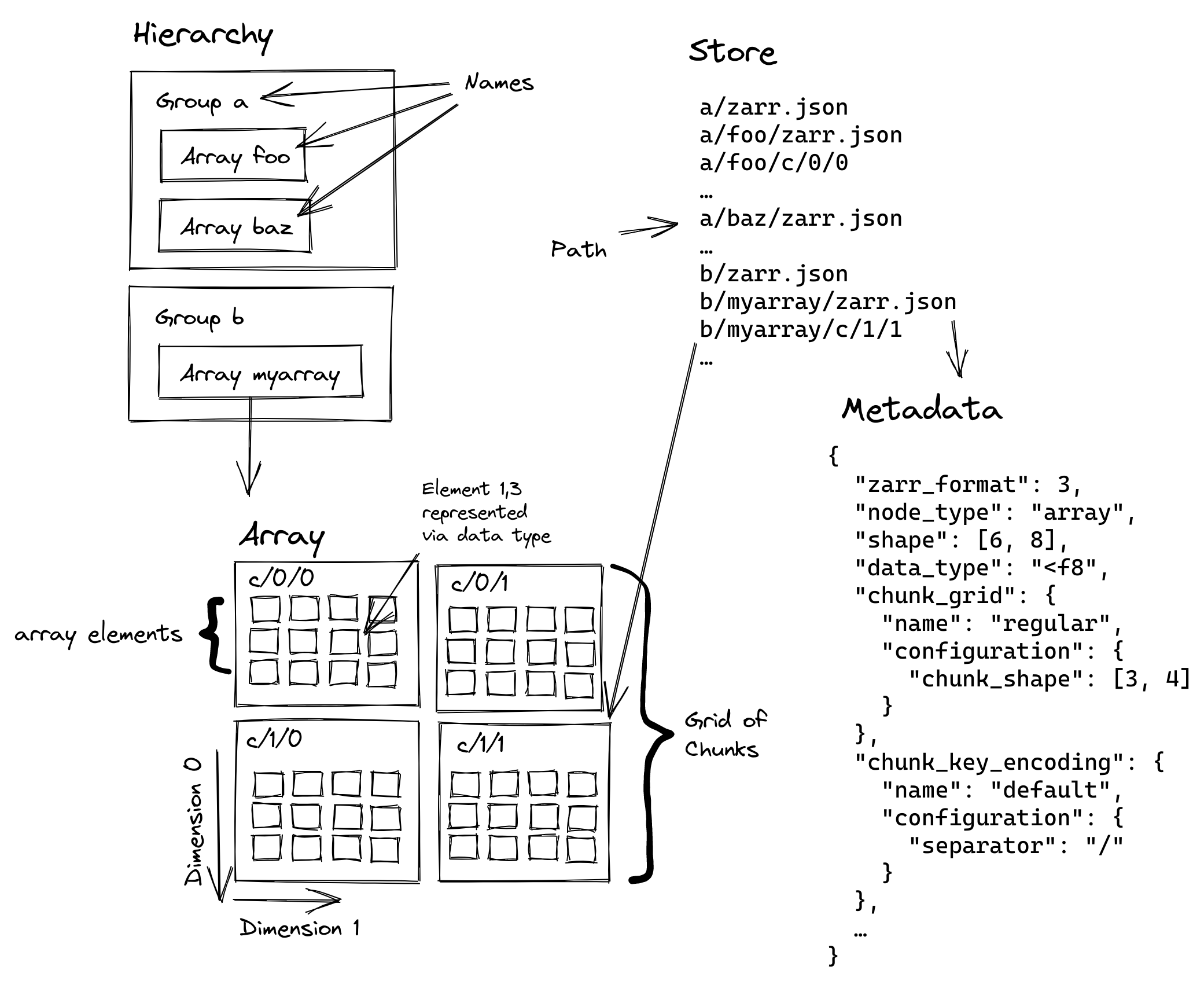
| "### Zarr Data Organization:\n", | ||
| "- **Arrays**: N-dimensional arrays that can be chunked and compressed.\n", | ||
| "- **Groups**: A container for organizing multiple arrays and other groups with a hierarchical structure.\n", | ||
| "- **Metadata**: JSON-like metadata describing the arrays and groups, including information about data types, dimensions, chunking, compression, and user-defined key-value fields. \n", | ||
| "- **Dimensions and Shape**: Arrays can have any number of dimensions, and their shape is defined by the number of elements in each dimension.\n", | ||
| "- **Coordinates & Indexing**: Zarr supports coordinate arrays for each dimension, allowing for efficient indexing and slicing.\n", | ||
| "\n", | ||
| "The diagram below from [the Zarr v3 specification](https://wiki.earthdata.nasa.gov/display/ESO/Zarr+Format) showing the structure of a Zarr store:\n", | ||
| "\n", | ||
| "\n", | ||
| "\n", | ||
| "\n", | ||
| "NetCDF and Zarr share similar terminology and functionality, but the key difference is that NetCDF is a single file, while Zarr is a directory-based “store” composed of many chunked files, making it better suited for distributed and cloud-based workflows." | ||
| ] | ||
| }, | ||
| { | ||
| "cell_type": "markdown", | ||
| "id": "1", | ||
| "metadata": {}, | ||
| "source": [ | ||
| "## Opening a dataset\n", | ||
| "\n", | ||
| "Let's open up a precipitation zarr store, with `xr.open_datatree(engine='zarr')`. This dataset was derived from \"GPM_3IMERGHH_07\" and \"M2T1NXFLX_5.12.4\" products and has a group hierarchical structure.\n", | ||
| "**NOTE** We selected `consolidated=True`, Zarr supports consolidated metadata, which allows you to store all metadata in a single file and can improve performance when reading metadata." | ||
| ] | ||
| }, | ||
| { | ||
| "cell_type": "code", | ||
| "execution_count": null, | ||
| "id": "2", | ||
| "metadata": {}, | ||
| "outputs": [], | ||
| "source": [ | ||
| "import xarray as xr\n", | ||
| "\n", | ||
| "precipitation_store = \"https://pub-45a1d62ac8d94c4c89f4dc63681a98ed.r2.dev/precipitation.zarr\"\n", | ||
| "\n", | ||
| "precip_dt = xr.open_datatree(precipitation_store, engine=\"zarr\", chunks={}, consolidated=True)" | ||
| ] | ||
| }, | ||
| { | ||
| "cell_type": "markdown", | ||
| "id": "3", | ||
| "metadata": {}, | ||
| "source": [ | ||
| "## Variable selection\n", | ||
| "As with on disk storage methods, data from zarr stores in the cloud can be accessed with either dict-like syntax or method based syntax with the `\"zarr\"` engine." | ||
| ] | ||
| }, | ||
| { | ||
| "cell_type": "code", | ||
| "execution_count": null, | ||
| "id": "4", | ||
| "metadata": {}, | ||
| "outputs": [], | ||
| "source": [ | ||
| "precip_dt.observed[\"precipitation\"]" | ||
| ] | ||
| }, | ||
| { | ||
| "cell_type": "markdown", | ||
| "id": "5", | ||
| "metadata": {}, | ||
| "source": [ | ||
| "This returns an `xr.DataArray` object with the underly data as a chunked `dask.Array`." | ||
| ] | ||
| }, | ||
| { | ||
| "cell_type": "markdown", | ||
| "id": "6", | ||
| "metadata": {}, | ||
| "source": [ | ||
| "## Time slicing\n", | ||
| "\n", | ||
| "Like a dataset stored on disk we can do time slicing on our zarr store. Each time slice is one hour data with a total of 10 hours of data. \n", | ||
| "\n", | ||
| "Let's try getting the first 5 hours of data with `.sel(time=)`. \n", | ||
| "\n", | ||
| "Since the time slices are ordered we can get a subset of the array of our time coordinate and pass it to the `.sel` method." | ||
| ] | ||
| }, | ||
| { | ||
| "cell_type": "code", | ||
| "execution_count": null, | ||
| "id": "7", | ||
| "metadata": {}, | ||
| "outputs": [], | ||
| "source": [ | ||
| "time_index = precip_dt.time[0:5]\n", | ||
| "precip_dt.sel(time=time_index)" | ||
| ] | ||
| }, | ||
| { | ||
| "cell_type": "markdown", | ||
| "id": "8", | ||
| "metadata": {}, | ||
| "source": [ | ||
| "We can also subset by time with a `datetime` string." | ||
| ] | ||
| }, | ||
| { | ||
| "cell_type": "code", | ||
| "execution_count": null, | ||
| "id": "9", | ||
| "metadata": {}, | ||
| "outputs": [], | ||
| "source": [ | ||
| "precip_dt.sel(time=slice(\"2021-08-29T07:30:00\", \"2021-08-29T16:30:00\"))" | ||
| ] | ||
| }, | ||
| { | ||
| "cell_type": "markdown", | ||
| "id": "10", | ||
| "metadata": {}, | ||
| "source": [ | ||
| "Or by the index of our time dimension `.isel(time=slice())`" | ||
| ] | ||
| }, | ||
| { | ||
| "cell_type": "code", | ||
| "execution_count": null, | ||
| "id": "11", | ||
| "metadata": {}, | ||
| "outputs": [], | ||
| "source": [ | ||
| "precip_dt.isel(time=slice(0, 5))" | ||
| ] | ||
| }, | ||
| { | ||
| "cell_type": "markdown", | ||
| "id": "12", | ||
| "metadata": { | ||
| "vscode": { | ||
| "languageId": "plaintext" | ||
| } | ||
| }, | ||
| "source": [ | ||
| "## Chunking\n", | ||
| "Chunking is the process of dividing arrays into smaller pieces, which allows for parallel processing and efficient storage.\n", | ||
| "\n", | ||
| "To examine the chunks in our Zarr store, with `xarray` you can use the `chunks` attribute on the `xr.DataArray` object." | ||
| ] | ||
| }, | ||
| { | ||
| "cell_type": "code", | ||
| "execution_count": null, | ||
| "id": "13", | ||
| "metadata": {}, | ||
| "outputs": [], | ||
| "source": [ | ||
| "precip_dt.observed[\"precipitation\"].data.chunks" | ||
| ] | ||
| }, | ||
| { | ||
| "cell_type": "markdown", | ||
| "id": "14", | ||
| "metadata": {}, | ||
| "source": [ | ||
| "### Selecting by chunks\n", | ||
| "\n", | ||
| "Since our underlying data arrays are `dask.Array`, we can access data from each chunked array in our Zarr store. \n", | ||
| "\n", | ||
| "Let's get the first chunk of the \"observed/precipitation\" variable in our zarr store.\n", | ||
| "\n", | ||
| "We add `.data` to our `xr.DataArray` to get access the `dask.Array`. The `.blocks[]` method allows you to index by chunk and `.compute()` returns the `np.ndarray`. " | ||
| ] | ||
| }, | ||
| { | ||
| "cell_type": "code", | ||
| "execution_count": null, | ||
| "id": "15", | ||
| "metadata": {}, | ||
| "outputs": [], | ||
| "source": [ | ||
| "precip_dt.observed[\"precipitation\"].data.blocks[0, 0, 0].compute()" | ||
| ] | ||
| }, | ||
| { | ||
| "cell_type": "code", | ||
| "execution_count": null, | ||
| "id": "16", | ||
| "metadata": {}, | ||
| "outputs": [], | ||
| "source": [ | ||
| "precip_dt.observed[\"precipitation\"].mean(dim=\"time\")" | ||
| ] | ||
| }, | ||
| { | ||
| "cell_type": "markdown", | ||
| "id": "17", | ||
| "metadata": {}, | ||
| "source": [ | ||
| "## Exercise" | ||
| ] | ||
| }, | ||
| { | ||
| "cell_type": "markdown", | ||
| "id": "18", | ||
| "metadata": {}, | ||
| "source": [ | ||
| "::::{admonition} Exercise\n", | ||
| ":class: tip\n", | ||
| "\n", | ||
| "Can you calculate and plot the mean precipitation starting at 09:55 for the reanalysis group in this zarr store?\n", | ||
| "\n", | ||
| ":::{admonition} Solution\n", | ||
| ":class: dropdown\n", | ||
| "\n", | ||
| "```python\n", | ||
| "precip_dt.reanalysis['precipitation'].sel(time=slice('2021-08-29T09:55:00', '2021-08-29T16:30:00')).mean(dim='time').plot()\n", | ||
| "```\n", | ||
| ":::\n", | ||
| "::::" | ||
| ] | ||
| } | ||
| ], | ||
| "metadata": { | ||
| "language_info": { | ||
| "codemirror_mode": { | ||
| "name": "ipython", | ||
| "version": 3 | ||
| }, | ||
| "file_extension": ".py", | ||
| "mimetype": "text/x-python", | ||
| "name": "python", | ||
| "nbconvert_exporter": "python", | ||
| "pygments_lexer": "ipython3" | ||
| } | ||
| }, | ||
| "nbformat": 4, | ||
| "nbformat_minor": 5 | ||
| } | ||

Uh oh!
There was an error while loading. Please reload this page.
There was a problem hiding this comment.
Choose a reason for hiding this comment
The reason will be displayed to describe this comment to others. Learn more.
learning objectives:
Reply via ReviewNB